• Skip to primary navigation
  • Skip to main content
  • Skip to primary sidebar

Givens Creative

Life at the intersection of faith, nature, history and art

  • Home
  • About
  • Blog
  • Spiritual Direction
  • Publications
  • CCG Music
  • Contact
  • Show Search
Hide Search

Steve

Kindness must follow faith

Steve · May 16, 2020 · 4 Comments

This originally appeared as a “Faith Perspectives” column in the St. Louis Post-Dispatch on May 15, 2020.

Ferguson Farmer’s Market, Ferguson, Mo.

During a safe and appropriately socially distanced online gathering recently, singer-songwriter Carrie Newcomer had this to say about what is required during this time of fear, confusion and isolation: “Kindness is love’s country cousin. It shows up and does the dishes without asking. Kindness —not grand gestures — will save the world. Love is big and hard to get our arms around. Kindness is human sized and changes everything.”

I paused for several weeks before considering how I might write about all that is going on (and not going on) in the world right now. After all, what could I say about the Corona virus and its effects on society that hasn’t been said in a hundred different ways by a thousand different writers? After a few days of such pondering, I landed on the need for the kind of kindness that is “human sized and changes everything.”

“Being kind” is, on one hand, obvious and simple. We teach it to both our toddlers and our dogs. But it is, on the other hand, perhaps the very best we have to offer right now, and it seems to be showing up in abundance. People are finding creative and appropriate ways to reach out in kindness and care for each other, even though they are — and must be — isolated from each other. Social media, for all its shortcomings, is at least giving us access to these moments of light right now. We are seeing nearly constant examples of those who are doing what they can to make the world a little brighter and connected in a time of uncertainty and distance.

Musicians are posting free “concerts” from their living rooms and kitchens. Publications are giving free access to content. People are supporting local restaurants and other businesses while maintaining that safe and critical distance. Churches and ministers are offering worship services, counseling and spiritual direction virtually, and the flock is lining up to use them.

And, of course, there are those who continue to provide direct services to those in need because they continue to respond to their chosen vocations, even knowing that it puts them and their families at risk. First responders and medical professionals head up that list, but those who stock our grocery stores, take away our trash, keep us informed and repair our infrastructure also deserve our gratitude. The next time we are tempted to complain about what’s not on the shelves, let’s look around and see everything that is. And let’s remember to leave enough for the next person in line.

For Christians, “being kind” is an imperative response to the gift of love we say we have received through Jesus. If we really believe that the greatest commandment is to love God with all of our hearts, souls and minds and to love our neighbors as much as (or more than) we love ourselves, then we must be prepared to do the very best and most kind things we can do right now. For most of us, that means staying inside and using the technology we have to stay in touch, to deliver comfort, to be creative and shed a little light on a world that has grown a little darker.

For those who must leave home and family to serve the rest of us, know that our gratitude and prayers go with you into the dark recesses of the human pain and suffering you must encounter and touch. We could use a few grand gestures of love and change right now, but let’s not give up on the small kindnesses that will continue to save the world.

So stay where you need to be. Wash your hands. Follow the rules. Feel our prayers, and be held in the palm of God’s hand.

Being There: Who Do You Say I Am?

Steve · May 11, 2020 · 3 Comments

In today’s reflection, based on Mark 8, I ask you to imagine yourself one of Jesus’ new followers. You’re not sure about him yet, not sure what it is you’re supposed to believe and feel. But your eyes are wide with wonder and your heart is open. Pray with this reflection, maybe read it a couple of times, and then ask yourself the question that Jesus asks his followers: Who do you say I am?

If you’d like, and if it will aid you in prayer, you can listen to this recording I made reading the reflection: Mark 8 — Who Do You Say I am?

Written and narrated by Steve Givens
Music composed and performed by Phil Cooper

You are not what anyone would call a disciple of this man yet, but here you are trailing along behind him and his followers, listening to his stories and staring open-mouthed and astounded as the most unusual and unbelievable things happen. You don’t know what to believe for sure, but there’s something going on here that is beyond anything you have ever experienced before. Something about him that urges you to follow just to see what happens next. If nothing else, he’s one heck of a teacher and magician. So you guess you’re a follower in that sense. You’re the quiet one at the back of the pack.

Just ahead, you hear his disciples bickering. Evidently, no one remembered to bring any bread to eat and there seems to be some confusion about whose responsibility that was. The teacher turns around and looks at them, disappointment on his face, as if he is dealing with a group of unruly children.

“Why are you worried about bread?” he says to them. “Don’t you know we’re about bigger things here? Don’t you get it? Have you forgotten a few days ago when I took five loaves of bread and fed 5,000 people? Do you not remember the baskets and baskets of leftovers?”

They stand looking at him with sorry, embarrassed eyes.

You remember, you think to yourself. That was your first day with him. Seven baskets of leftovers. That was some trick.

“We didn’t forget,” one of them says, “But we didn’t want to bother you again…”

“We don’t expect miracles every day,” says another, laughing.

“It’s not about the bread,” he responds, his eyes soft now with compassion. “It’s about the trust. Trust me. Every day is a miracle.”

You arrive at Bethsaida. As you have seen happen in just about every town he enters, he is quickly surrounded by people wanting something from him. They want a story. They want to see a miracle. They want to be healed or see him heal. They want proof. As do you. This never gets old, you think.

Up through the crowd comes a trio of people pulling behind them a blind man on a rope. He stumbles behind them, his arms stretched out in front of himself, grasping at air and preparing for any abrupt stop. “Please, heal our friend,” they say.

Jesus turns and looks at the man, compassion and love on his face. First, he unties the rope and takes him by the hand, leading him back out of the village and away from the noise and crowds.

Then he does the most remarkable thing. He spits in his own hands and then gently rubs the spittle into the man’s eyes. He embraces the man’s head, cradling it like a treasure. You inch closer, longing to hear what is being said. Jesus asks the man: “Do you see anything?”

The man looks up and his once-sightless face glows red-orange in the late afternoon soon. “I see men,” he says, looking around at you and the disciples, smiling and trying to find the right words for something he has never seen before but only imagined. “They look like walking trees.”

Jesus smiles at his words and stretches out his arms once again. “I can make it perfect,” he says, once again taking the man’s face into his hands. The man clings to Jesus, as if he doesn’t ever want the embrace to end, afraid that his lack of faith might push him back into darkness.

“Go straight home and show yourself to your family,” Jesus says. “See them perfectly.”

The man backs away from Jesus and the look on his face tells you all you need to know. He sees you. He sees you looking at him. “How can this be?” he whispers to you, and you have no response worthy of what you have just experienced.

You are on the move again, walking in the wilderness and headed out for the villages around Caesarea Philippi. As you and the others pause and gather around him, Jesus asks: “Who do the people say I am?”

One of his disciples answers, “Some are confused and say you are ‘John the Baptizer. Some say Elijah. Others say you are one of the prophets.”

“And you,” he says, looking straight at you, the quiet one at the back of the pack. Who do you say I am?”

It’s Time to Forgive. Right now. Today.

Steve · April 30, 2020 · 4 Comments

In the midst of everything that is going on in the world, during this time of danger and fear and loss, ask yourself: Who do I need to forgive or ask forgiveness from? What if tomorrow they were gone?

Get rid of old grudges. They hurt you more than anyone else.

Songs of Comfort: On Eagle’s Wings

Steve · April 22, 2020 · 8 Comments

Note: I interviewed Fr. Jan Michael Joncas a few weeks ago about the enduring power and comfort of his song, “On Eagle’s Wings” for Catholic Digest magazine, which went out of print not long after the assignment. So with Fr. Joncas’ permission, I am posting the article here.

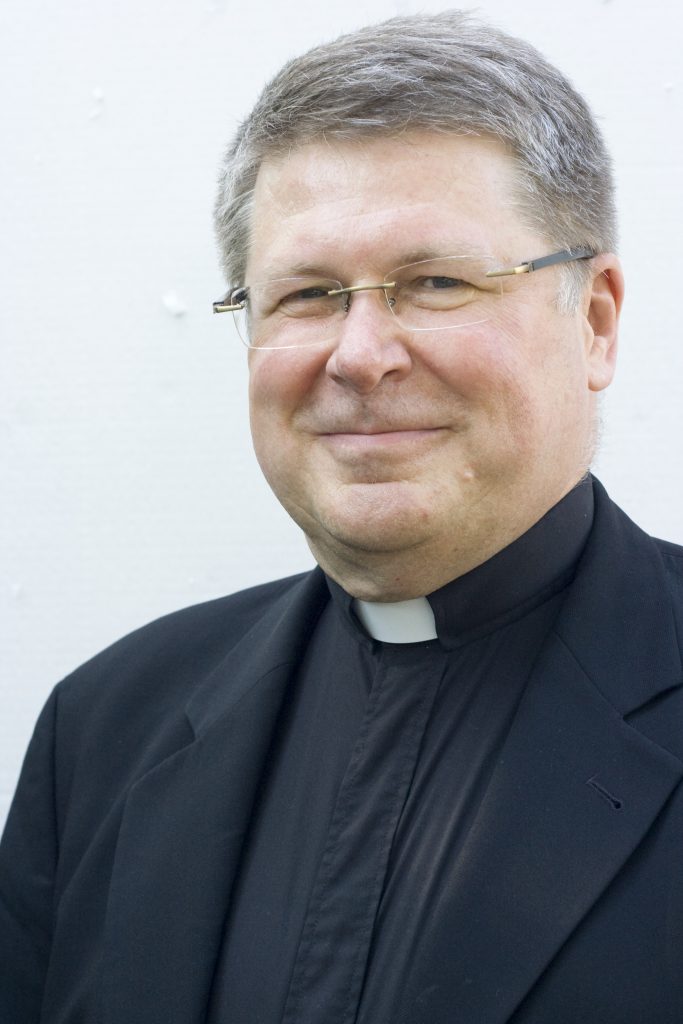
Fr. Jan Michael Joncas, courtesty photo.

When Fr. Jan Michael Joncas composed the song “On Eagle’s Wings” four decades ago, he was trying to comfort a friend whose father had just died of a heart attack. He wrote the song on guitar in the days following the death and then performed it at the funeral, and that might have been the end of the story. But God, Fr. Joncas said in a recent interview, had other plans.

“It’s just amazing to me,” said Joncas, 68, a prolific composer, priest of the Archdiocese of St. Paul and Minneapolis, and artist-in-residence and research fellow in Catholic Studies at St. Thomas University. “I had no way of knowing, first of all, how it got distributed so that people could use it. But by now, it’s made its way across most of the English-speaking world and into other denominational hymnals.”

Even higher-profile uses of the song include recordings by superstars like Josh Groban and Michael Crawford, as well as its performance at the memorial service for the 1995 Oklahoma City bombing victims and at the funeral of opera singer Luciano Pavarotti.


“I never expected anything like this to happen,” said Fr. Joncas, quarantined at home in St. Paul, “but as I’ve grown older, I’ve grown more and more comfortable with it. I tell my friends that to even have written one piece that has allowed this many people to sing their faith is an incredible gift. Even if nothing else I’ve written ever has that same kind of distribution or power, I’m still happy with it. God does what God wants with this stuff. I am just more and more amazed at how God can use things that you might not ever have thought of to advance whatever God’s intentions are.”

And although it’s become one of a handful of contemporary hymns that have become staples at funerals, Fr. Joncas believes its scriptural roots in Psalm 91, as well as in Exodus and the Gospel of Matthew, make it a song of comfort for the many confusing and fearful times of our lives, as well as for ordinary and joyful times like baptisms and weddings.

“I’m going to use my academic background here,” he said, laughing quietly. “It’s the multivalence [ability to have many values and meanings] of any kind of canonical text scriptures that give them really different importance or different meanings based on the context in which they are used. So the context for ‘Eagle’s Wings’ has been in most people’s experience of funerals, but it’s not limited to that.”

The fact that the song can often make people cry – not because it’s sad but because it’s so comforting — is a gift of the Spirit, said Fr. Joncas, who in 2003 was diagnosed with Guillain-Barré Syndrome, a disorder in which the body’s immune system attacks the nervous system. He was paralyzed for several years and unable to compose. He wrote about his experiences of the disease in “On Eagle’s Wings: A Journey Through Illness Toward Healing,” released in 2017 by Twenty-Third Publications. It was that experience, he says, that allowed him to move beyond his Midwestern stoicism.

“The Eastern traditions talk about the gift of tears, which I think is really accurate,” he said. “I’m a now-beyond-middle-aged, Caucasian Midwesterner, which means that expressions of deep emotion just don’t come to me naturally. After my experience with Guillain-Barré, I found that I’m much more able to trust the feelings, to let them come out, and to connect empathically with people.”

It is, perhaps, the song’s central and vivid image of being “held in the palm of his hand” that gets us every time. It’s a physical impossibility, but it’s the emotional driver of the song. And that’s the power of scripture, Fr. Joncas says.

“One of the things I teach is that psalms are the cries of the human heart, that even though these are ancient Jewish lyrics, they have this wonderful ability to enter very deeply into human experience and then allow that experience to become a way of encountering God.”

At this moment in time, when the world is wracked by disease and the fear of the unknown, Fr. Joncas suggests that leaning on ancient texts like the Psalms can be a healing salve precisely because there’s nothing new under the sun.

“Although this [pandemic] is certainly unprecedented in our memory, there are people who can point to the Spanish influenza right at the beginning of the 20th century. As a historian, I can say, ‘well, it’s not the black death where a third of Europe simply disappeared over the course of a couple of years.’ We’ve faced this kind of difficulty before. But I think the scary part is we’ve got so much good science and technology that we thought we’d be protected from anything like this. So it really pulls the rug out from underneath our expectations.

“When that happens, I think going back to texts from our heritage is important, and songs of comfort remind us of a time when we have already experienced God’s care, and it’s kind of an act of trust that God will continue to care for us.”

In the palm of his hand.


The Beatitudes teach us where to stand

Steve · April 17, 2020 · 6 Comments

“The Beatitudes are a geography. They teach us where to stand.”
– Fr. Greg Boyle, SJ

Below is a new, short, spoken-word video from me inspired by an idea from Fr. Greg Boyle, SJ.

“We’re in the right place if: A new look at the Beatitudes.” Written and narrated by me, with music by my friend and collaborator John Caravelli.

If you’d like to read the words, see this previous post.

  • « Go to Previous Page
  • Page 1
  • Interim pages omitted …
  • Page 13
  • Page 14
  • Page 15
  • Page 16
  • Page 17
  • Interim pages omitted …
  • Page 75
  • Go to Next Page »

Primary Sidebar

Subscribe to Our Newsletter

Check your inbox or spam folder to confirm your subscription.

Categories

  • A (Very) Short Story
  • Being There
  • Blessings
  • Book Reviews
  • Chemotherapy
  • Christmas
  • Creative Spirit
  • Creativity
  • Games We Played
  • Guest Bloggers
  • History
  • House concerts
  • Ignatian Spirituality
  • Leadership
  • Music
  • My Soundtrack
  • Nature
  • Notes from a Lecture
  • Photography
  • Poetry
  • Prayer
  • Scripture
  • Songwriters
  • Spirituality
  • Sports and Culture
  • Stem Cell Transplant
  • STLToday Faith Perspectives
  • Today's Word
  • Travel
  • Two Minutes
  • Uncategorized
  • Vocation & Call

Recent Comments

  • Steve on All Signs Point to the House of God
  • Steve on We are the Leftover Fragments
  • Chris on We are the Leftover Fragments
  • Pat Butterworth on All Signs Point to the House of God
  • Steve on Wonder as the Foundation of Prayer

About the Author

Steve Givens is a retreat and spiritual director and a widely published writer on issues of faith and spirituality. He is also a musician, composer and singer who lives in St. Louis, Mo., with his wife, Sue. They have two grown and married children and five grandchildren.

Read More >>>

Recent Posts

  • Still the Rocks Cry Out
  • For Just One Night – Hope and Peace
  • Let’s Go Around the Table (in Detail)
  • All Signs Point to the House of God
  • Wonder as the Foundation of Prayer

Recent Posts

  • Still the Rocks Cry Out
  • For Just One Night – Hope and Peace
  • Let’s Go Around the Table (in Detail)
  • All Signs Point to the House of God
  • Wonder as the Foundation of Prayer
  • Home
  • About
  • Blog
  • Spiritual Direction
  • Publications
  • CCG Music
  • Contact

Reach out to connect with Steve Send an E-mail

Copyright © 2026 · Built by Jon Givens · Log in