• Skip to primary navigation
  • Skip to main content
  • Skip to primary sidebar

Givens Creative

Life at the intersection of faith, nature, history and art

  • Home
  • About
  • Blog
  • Spiritual Direction
  • Publications
  • CCG Music
  • Contact
  • Show Search
Hide Search

sacred

Today’s Word: Unbelief

Steve · October 2, 2013 · 2 Comments

Foxtail weed at the end of summer. SJG photo

In response to Jesus’ statement, “Everything is possible to one who has faith,” the father of a possessed child in Mark 9 cries out: “I do believe, help my unbelief!” And with those words, perhaps not a more honest statement of faith has ever been spoken.

As a spiritual director, I have met with individuals who tell me that they are not sure they believe in God or that they have doubts in the divinity of Christ. Fair enough. In fact, a little disbelief or doubt on occasion might be just what we need to draw ourselves closer to God and see again with new eyes and fresh senses all that God has to offer. The opposite of doubt is not necessarily faith. The opposite of doubt may be a numb, mindless walk through life where we don’t stop to think about much of anything one way or another. That’s a sadder life that offers little chance to see the grace in the world around us. At least doubt says, “I’m not sure,” and perhaps opens the door to belief, especially if we’re willing to pray: “I’m not sure I believe in you but…if you’re there…help me out a little.” That’s faith, perhaps the size of a mustard seed, and it’s all we need. For that little nugget of faith helps us overcome our doubts, helps us to not be too overwhelmed by our disbelief. Faith is a gift, a chance to glimpse the sacred in an all-too-faulty human world. Faith allows us to embrace what we don’t understand, knowing that this “sacred ambiguity” nevertheless draws us closer to the mystery of God. What we need is just enough faith to ask for more.

Ask yourself in silence: Can I find belief in my disbelief? Do I have enough faith to ask for a little more?

Today’s Word: Labyrinth

Steve · September 15, 2013 · 8 Comments

Peace at the center. Mercy Center, St. Louis. SJG photo

Yesterday, while at an ecumenical day of reflection for spiritual directors, I had the opportunity to walk a labyrinth at Mercy Center in St. Louis. I’ve heard and read about labyrinths, but this was my first time experiencing one. Unlike an English garden maze, which I have experienced (and it was frustrating and a little scary…) a labyrinth offers only one path and it’s not out to trick you or get you lost. There are no high hedges to hem you in, only parallel rows of white rocks and a mulched walkway. There’s only one way in and one way out. So setting my own pace and simply following the path, I was moved — however rambling — toward the labyrinth’s peaceful center under a tree.

There’s nothing inherently mystical or sacred about a labyrinth, for it’s the intention and attention of the walker that makes the path holy. But I found it to be a gentle, guiding tool for meditation on the movement of God in my life, a meaningful melding of the spiritual and the physical.

Labyrinth at Mercy Center, St. Louis. SJG photo

It is, of course, an apt metaphor for our spiritual journey, for only by continuing to walk and trusting the path we are on and its Creator can we reach the center where God waits for us, patient as a friend and lover. And like the labyrinth, God is not out to trick us or set traps for us, for when following the way of Christ (“I am the way, the truth and the life…”) we do not need to worry about which way to turn, as long as we keep to the path. The call of the labyrinth, like the call of God, is to quiet our minds, to trust our steps and to move ever forward to the center, the unmoving mover of all.

Ask yourself in silence: Do I trust the path I am walking?  If not, am I on the wrong path?

Today’s Word: Pilgrim

Steve · September 14, 2013 · 1 Comment

Life isn't a destination. SJG photo

To be on a journey as a pilgrim — whether real or metaphorical, whether alone or with others — is to walk with the certainty that we are walking a road that many others have travelled before us. And so we are never alone, guided as we are by this communion of saints and common souls— this ragamuffin band — and led by the footprints, signs and traces of all who have come before us.

The wisdom we seek on this journey, while perhaps contained in the writings and experiences of these prior pilgrims, can really only be found by walking the journey and allowing the knowledge to seep into our deepest being. And there we begin to make some sense of the trip, with all its twists and turns, dead ends, false avenues and strange forks in the road. Wisdom lies in our lived and contemplated experiences of our own unique journeys. Wisdom comes in reflection, in the integration of the multitude of our sacred moments with all that we have read and heard. For faith comes through listening, through hearing the sacred word of God in scripture and in the stories of those who walk with us and before us.

A stone in the labyrinth, Mercy Center, St. Louis. SJG photo (click to view larger)

Ask yourself in silence: Am I paying attention to the journey I am on? Am I noticing the turns and watching for the signs that lead me to an abundance of life in God?

Today’s Word: Watching

Steve · September 7, 2013 · Leave a Comment

Watching for the Other. SJG photo

“Vocatus Atque Non Vocatus Deus Aderit.” (“Bidden or not bidden, God is present.”)
– Dutch theologian, humanist and priest Desiderius Erasmus

What does it say about us that we spend our lives looking for something that cannot be seen? How many times have I said or written, “watch for the movement of God in your life?” Some might think it means I’m a little off my rocker, or perhaps that I’m well intentioned but, of course, dead wrong. Foolish. Sadly mistaken. In some ways, I guess I can see their point. I might be wrong, after all. Perhaps there is no God to be found. No God to be seen or present in our lives.

So why waste my breath or blog space talking about all this God stuff and God’s movement in our lives? Because I can fathom no other way of living a loving, creative life. Because this “God,” this “other” keeps showing up in my life and in the lives of those around me. Because — rooted in divine love and the example of Christ — we choose to live lives of faith, hope and love, lives that take us beyond ourselves and embed us in the love and grace of the unmoved mover and the giver of life. We choose life in Christ, we choose belief in God, because we know it to be true by our own experiences. We know it somewhere deep.

God is not just a good idea, created by humans to indulge and comfort us. Neither is God “out there.” God — bidden or not bidden — is here and now, and if we are watchful we will catch glimpses of the Other as we walk and work through life. So we slow down, we pay attention, and we wait for those fleeting, sacred glances that sustain.

Ask yourself in silence: Do I watch for God in my life? When did I last see God?

Today’s Word: Crucified

Steve · August 31, 2013 · 1 Comment

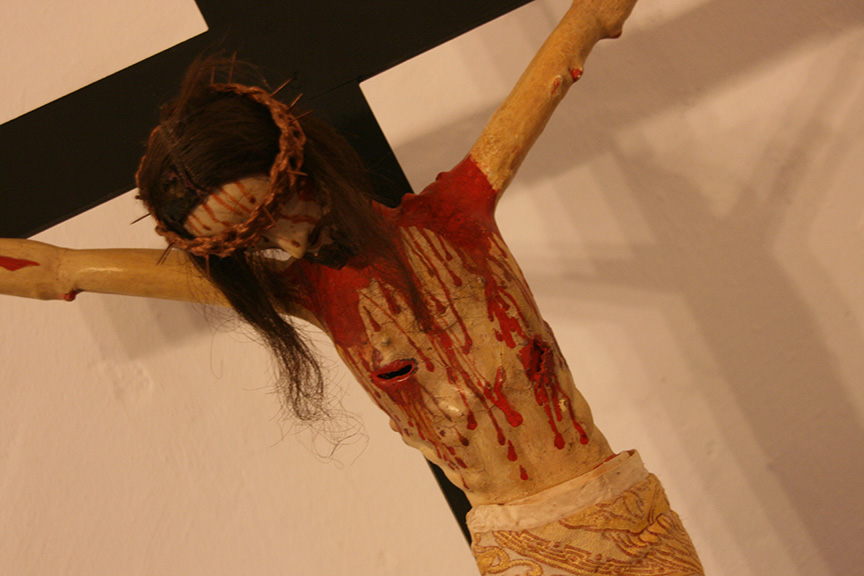
Crucifix at San Antonio de Pala Asistencia mission, California. SJG photo.

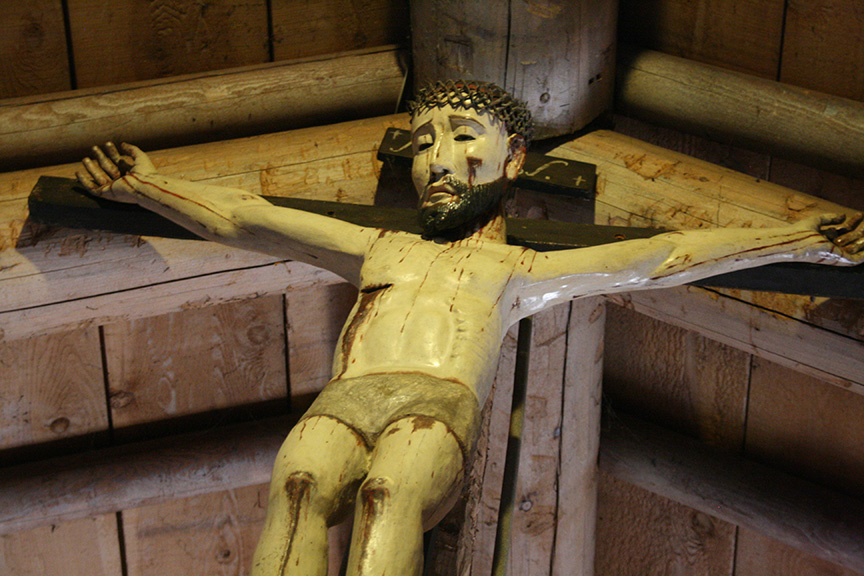
The cross and the crucified Christ have become so ubiquitous in the lives of modern day Christians that we can sometimes forget what we are looking at and what it means for us. The image of Christ crucified passed down to us from European art and liturgical traditions generally shows a muscular, strong, triumphant Christ, even if he is shown in misery. And, of course, he usually looks distinctly European. Go figure. While visiting some of the mission churches in California and Texas, I have seen a different Christ emerge. And while some of the differences can be attributed to the nature of folk art vs. classical art, the result is nevertheless a bit more disturbing. The images pull no punches. This is pain. This is Christ as lamb of God, taking away the sins of the world. This is Christ as man and animal, as a beast of burden.

In Shusaku Endo’s novel, “The Samurai,” the Japanese-Christian author describes the crucified Christ as, “that ugly, emaciated figure with arms and legs nailed to a cross and his head hanging limply down.” So why are we drawn to this pathetic figure, this failure? Endo writes: “Somewhere in the heart of men there’s a yearning for someone who will be with you throughout your life, someone who will never betray you, never leave you — even if that someone is a sick, mangy dog. That man became just such a miserable dog for the sake on mankind.”

Crucifix at San Antonio de Pala Asistencia mission, California. SJG photo.

This is the stuff we don’t much like thinking about and words we rarely if ever use. This is powerful, disturbing imagery, but it rings true somewhere deep down. This God-with-us, this Jesus, became a slave, a mangy dog. It was why he came. Yet he becomes the triumphant slave — the victor, the overcomer — not for himself, but for us. Without the crucifixion and subsequent resurrection, all of our prayers and worship are empty and in vain. Without this ghastly death, there is no hope of new life.

Ask yourself in silence: Is this my Christ? Am I willing and able to pray to Christ crucified? Where does he fit in my life?

  • « Go to Previous Page
  • Page 1
  • Interim pages omitted …
  • Page 3
  • Page 4
  • Page 5
  • Page 6
  • Page 7
  • Interim pages omitted …
  • Page 11
  • Go to Next Page »

Primary Sidebar

Subscribe to Our Newsletter

Check your inbox or spam folder to confirm your subscription.

Categories

  • A (Very) Short Story
  • Being There
  • Blessings
  • Book Reviews
  • Chemotherapy
  • Christmas
  • Creative Spirit
  • Creativity
  • Games We Played
  • Guest Bloggers
  • History
  • House concerts
  • Ignatian Spirituality
  • Leadership
  • Music
  • My Soundtrack
  • Nature
  • Notes from a Lecture
  • Photography
  • Poetry
  • Prayer
  • Scripture
  • Songwriters
  • Spirituality
  • Sports and Culture
  • Stem Cell Transplant
  • STLToday Faith Perspectives
  • Today's Word
  • Travel
  • Two Minutes
  • Uncategorized
  • Vocation & Call

Recent Comments

  • Steve on All Signs Point to the House of God
  • Steve on We are the Leftover Fragments
  • Chris on We are the Leftover Fragments
  • Pat Butterworth on All Signs Point to the House of God
  • Steve on Wonder as the Foundation of Prayer

About the Author

Steve Givens is a retreat and spiritual director and a widely published writer on issues of faith and spirituality. He is also a musician, composer and singer who lives in St. Louis, Mo., with his wife, Sue. They have two grown and married children and five grandchildren.

Read More >>>

Recent Posts

  • For Just One Night – Hope and Peace
  • Let’s Go Around the Table (in Detail)
  • All Signs Point to the House of God
  • Wonder as the Foundation of Prayer
  • We are the Leftover Fragments

Recent Posts

  • For Just One Night – Hope and Peace
  • Let’s Go Around the Table (in Detail)
  • All Signs Point to the House of God
  • Wonder as the Foundation of Prayer
  • We are the Leftover Fragments
  • Home
  • About
  • Blog
  • Spiritual Direction
  • Publications
  • CCG Music
  • Contact

Reach out to connect with Steve Send an E-mail

Copyright © 2026 · Built by Jon Givens · Log in