• Skip to primary navigation
  • Skip to main content
  • Skip to primary sidebar

Givens Creative

Life at the intersection of faith, nature, history and art

  • Home
  • About
  • Blog
  • Spiritual Direction
  • Publications
  • CCG Music
  • Contact
  • Show Search
Hide Search

Prayer

Looking for Hope in all the Wrong Places

Steve · October 30, 2020 · 18 Comments

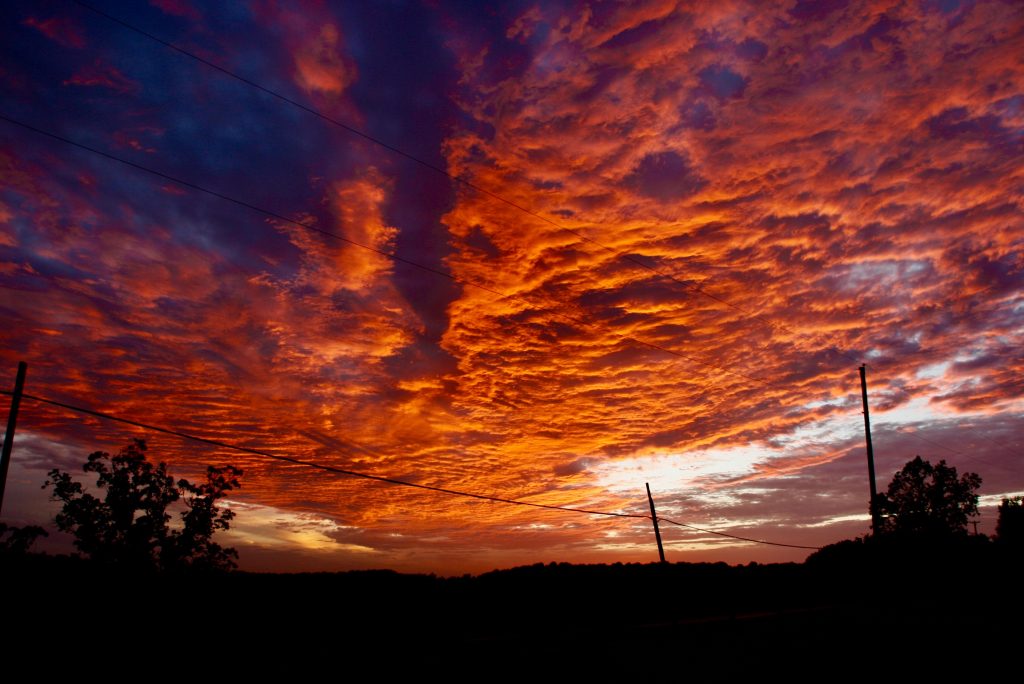
Sunset in southern Illinois. Photo by SJG.

It’s a cold and sunny day
here in St. Louis, following a number of days of cold and wet. Fall is sinking fast and winter is lurking in a tree somewhere not too far off, ready to sweep in like a red-tailed hawk on us unsuspecting varmints just doing our best to gather enough energy for the long road ahead. 

On top of all that seasonal analogy, of course, is the general state of the world. We’re still hunkered down and masked up (at least we are in my family and circle of friends) against a sneaky and unforgiving virus that scientists are still struggling to understand and create a vaccine for. The national election is a few days off and, no matter which side you choose and vote for, you are likely feeling a sense of foreboding and even fear about the results and what it will mean for the United States in the foreseeable future. The country and the world seem to be in a state of unrest, incivility and hopelessness that many of us have never experienced. 

It’s easy to lose hope, and perhaps it’s even easier to place our hope in the wrong things and people. I’m not here to tell you what’s right and what’s wrong. But since the theme of this blog has always been — broadly defined — about the intersection of God in our lives, I would like to make a few observations today and then leave you with a song and prayer of hope written by one of my very close friends and creative collaborators. 

First, a few observations about hope:

  • No elected official and no political party’s platform will restore hope to us; we will have to find a way to do that ourselves. 
  • If we hope for a better and more civil society, we will need to begin with the way we treat everyone around us and not look to leaders to emulate it. They will undoubtedly let us down.
  • If we hope to count ourselves among the friends of Jesus, we need to remember that when Jesus was asked about the greatest commandment, he didn’t lay out a complicated set of rules that told us if we could be in his inner circle or not. He just said: “Love God and love your neighbor as yourself.” There’s hope in that. 
  • And if you’re not sure who your neighbor is or think it is just those people who live in your neighborhood and look, love, believe and act like you, remember again the words of Jesus in the parable of the good Samaritan: “Our neighbors are those in need.”   

There is, despite all evidence to the contrary, reason for hope right now, but only if we are are willing to recommit ourselves to the teachings and love of Christ and only if we’re willing to do the hard spiritual work of using those teachings of love, forgiveness and grace as the foundation for the way we interact with the world. 

Still, we may find it hard to hope right now. 
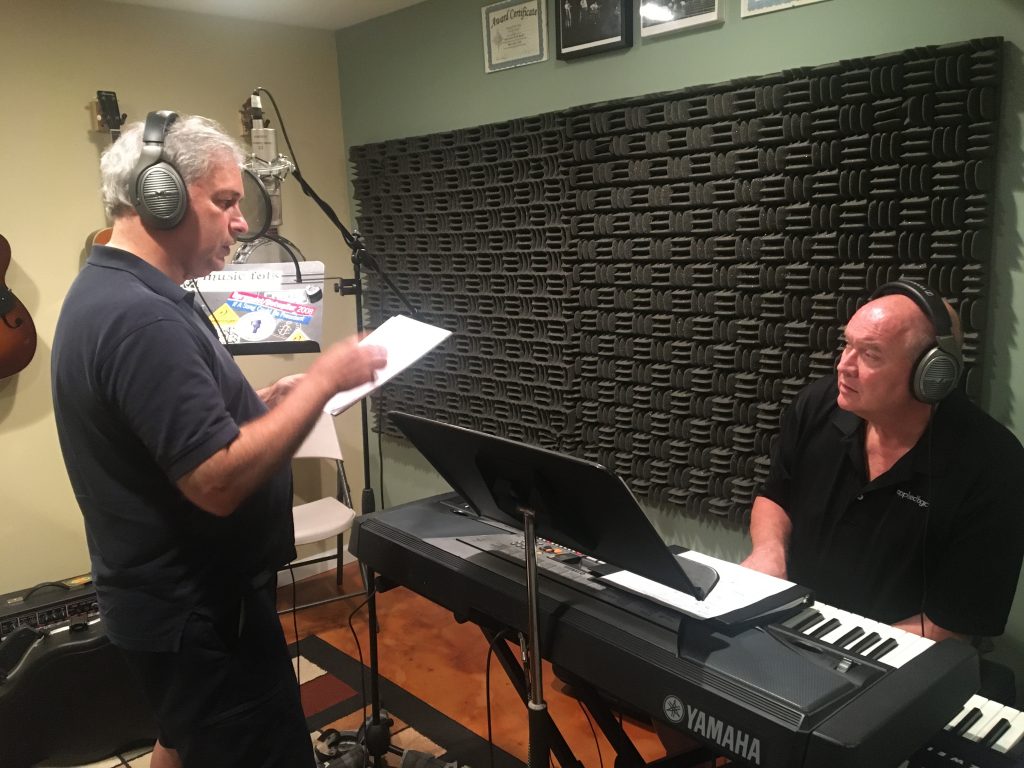
My friends and collaborators John Caravelli, left, and Phil Cooper, working out the arrangement of “It Looked Like Hope.”

“We have all been there,” writes my friend and collaborator John Caravelli. “You may call it emptiness, a dry spell or a dark night of the soul. Many of us are feeling that way right now and for good reason. We are in the midst of a deadly pandemic. This election season has been filled with uncivil discourse, reported to us incessantly via social media and a 24-hour news cycle. We are experiencing the consequences of racial divisions and climate change. Whatever the reason, we can all find ourselves feeling lost, angry or sad for periods in our lives.”  

Acknowledging all those emotions and yet holding out for something better, John wrote a song not about the darkness but the light, about what we experience when the heaviness lifts.  
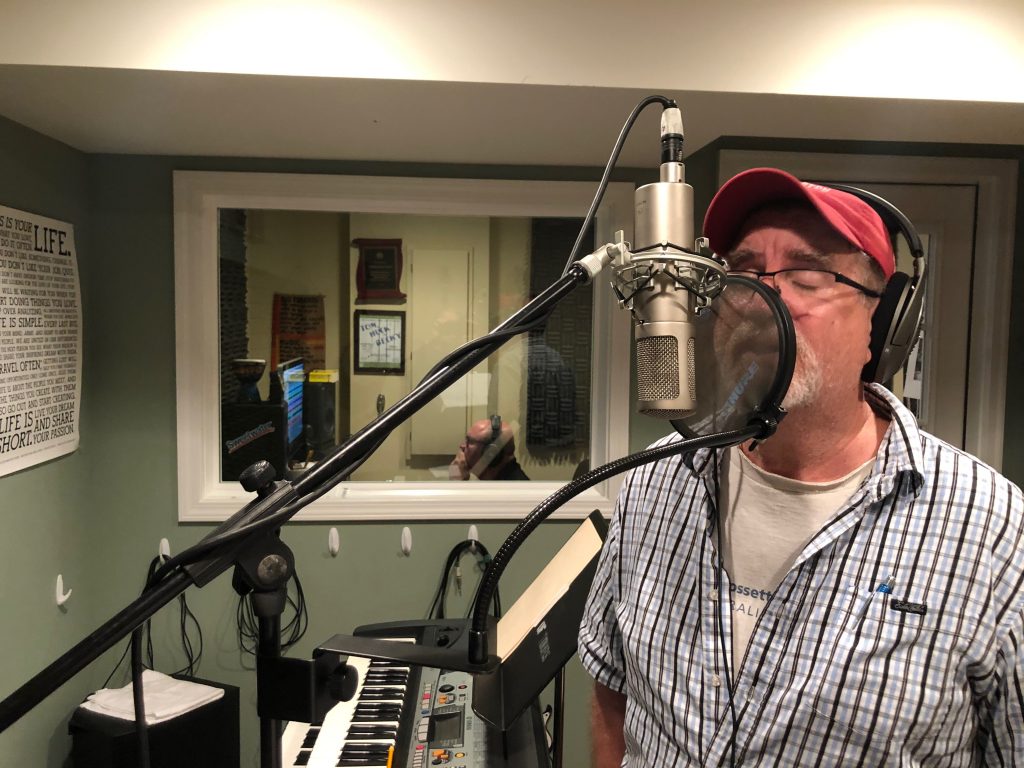
That’s me, singing. Photo by John Caravelli.

“Very often, it’s not something you can really identify, but you know when it happens,” he says.  “Suddenly, you notice more about what is right with the world and not only what is wrong. You see the beauty, the kindness, the love and the blessings. Despair gives way to hope, as it should.”

John wrote the song, “It Looked Like Hope,” about the experience of searching for hope in all the right places — in an autumn day, by the light of a full moon, in the dawning sun, in places where we might least expect to find it — and finding in those still moments not just beauty but the very face of God; of knowing, like Julian of Norwich, that “all will be well and all will be well.” That God is near, no matter how we’re feeling about it. 

John let me do the singing while he played guitar, and our friend and third collaborator in the CCG songwriting trio, Phil Cooper, played the keyboard. John and I produced the video below, and I added a quote at the end from John’s favorite saint, St. Therese of Lisieux, which seemed to sum up how we were feeling, or at least hoping:

Above the clouds, the sky is always blue.

It Looked Like Hope

It’s been a long time coming
It’s been a long time tired
I’ve been lost and angry
As if some evil fates conspired.

Dark autumn wind blew all day
There was a hunter’s moon last night
It shone through my bedroom window
My bed glowed in the Lord’s moonlight.

And when the dawning sun broke through the clouds,
From my dream as I awoke,
I believe I saw the face of God
I believe it looked like hope.

But there’s an end to every dark road
The light will shine at last
A song of hope will deliver you
From a helpless lonely past.

I believe I heard the angels sing
A pure and simple song
To relieve me of the mournful tune
I’ve been singing much too long.

And when you least expect it
In a dream that you have, in a song that you hear 
It’s then that you know 
That all will be well, and all will be well
That your God is near, that your God is near

I believe I heard the angels sing
A pure and simple song
To relieve me of this mournful tune
I’ve been singing much too long.

And when dawning sun broke through the clouds,
From my dream as I awoke,
I believe I saw the face of God
I believe it looked like hope.
I believe I saw the face of God
I believe it looked like hope.

Words and music by John Caravelli. Copyright 2020 Potter’s Mark Music.
Prayer Time: Waiting for My Return

Steve · July 2, 2020 · 10 Comments

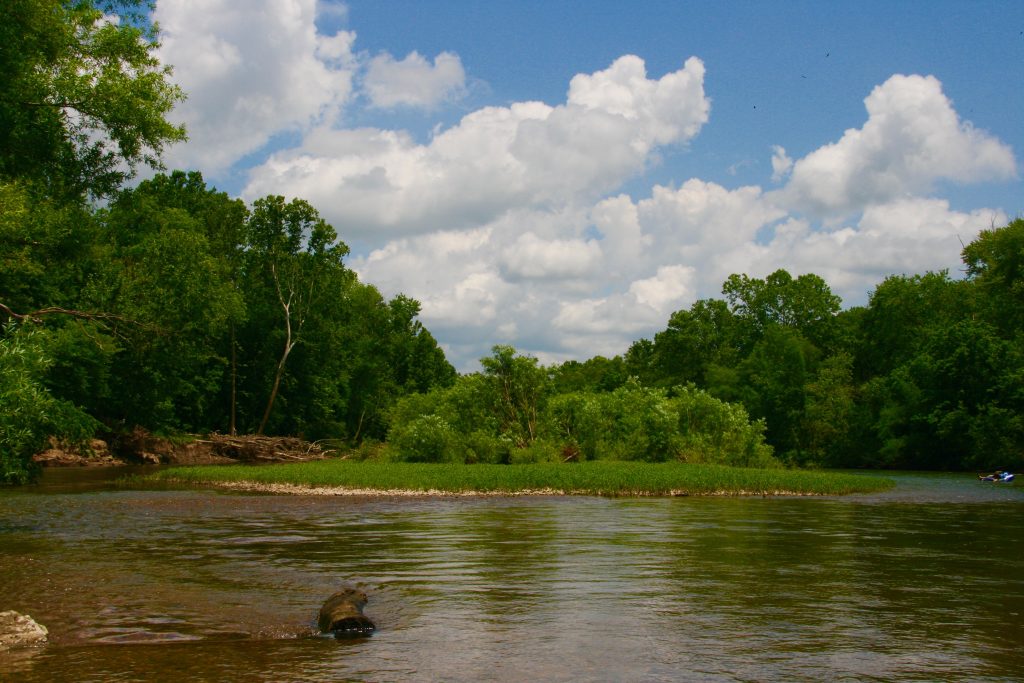
Father’s Day 2020 on the Meramec River in the northern Ozarks.

Today I awoke to a cool and refreshing morning that I know will sizzle and steam away as St. Louis-in-July heat and humidity takes hold of the rest of the day. On the back porch I watched the goldfinches visit their feeder and waited for the doe and two fawns to take their daily stroll through the property behind me.

I need this time in the morning, a time to slow and quiet down, a chance to regather my thoughts and point myself in the direction of Creator and creation. I slipped on my headphones and listened to my friend and musical collaborator Phil Cooper’s beautiful solo piano piece aptly called “Prayer Time,” composed back in 2005. I listened again and again, and the images that appeared were ones of flowing water — refreshing, cleansing, new and as ever-present and ever-changing in our lives as the great unchanging changer we call God. These lines came to me:

You are a stream running through me
flowing forth from deep within
seeping in like some ancient spring
hidden in the grass by the corner of the field.

Even in dry seasons you remain
a trickle of nourishment and hope in my dryness
never fully gone, only lost in the tall grass for a spell
still ever present and watching, waiting for my return.

The images and emotions of this running water kept coming, so I spent the rest of the morning creating the video below for Phil’s music. You need and deserve these three minutes.

Grace and peace to you. Grab some silence and solitude for yourself. God will show up.

With the Faith of a Child (with video)

Steve · June 11, 2020 · 2 Comments

Jason Parker Deffenbaugh. He smiles when I sing to him, and that can be the best part of my day.

Earlier this week, I was holding my youngest grandson, Jason. He was born prematurely back in January and weighed in at less than four pounds. Five months later, he is up over eleven pounds and doing well. As I held him, I thought about what it means to have the kind of “childlike faith” that Jesus asks of us. What does it really mean?

I don’t think it means unquestioning or naïve faith, first of all, nor does it mean blind faith that leaves no room for reason and a developed mind that questions. The faith of a child, I think, is about living in abundance and potential. It’s about trusting that we will be provided for and that from that abundance comes the belief that all things are possible through Christ.

Children believe they can accomplish anything they set their minds to because they haven’t yet been given a false sense of their own limitations. That will come soon enough. But while they are children, their “enough” is being held and fed, comforted and protected, playing and sharing and quickly forgiving, even when they don’t understand the world and all it holds.

And isn’t that the kind of faith Jesus wants us to have?

Today, I offer a new song and video created just this week with my songwriting partner and friend John Caravelli. Between us, we have eleven granddaughters, and this is a song for them, their joy, their resilience, their faith.

Content being branches, bearing fruit

Steve · June 1, 2020 · 10 Comments

Last week, on my drive home from a long walk at a nearby county park, I noticed a sign at a local farm announcing that strawberries were ripe and ready for sale. I had been watching and waiting and hoping for this sign. I pulled onto the gravel road, drove the short distance between the fields from highway to shed, and parked the car.

I donned my mask as we all must do these days, but I think the woman behind the till could still see the smile on my face as I picked out a few cartons and paid. “I’ve been waiting for this,” I told her.

Back in the car, I set the strawberries on the seat next to me, already googling a recipe for shortcake and planning a nice surprise for our evening meal. But before I put the car in reverse and left the farm, I reached over and grabbed a plump red berry and bit into it. Still warm from the sun, it melted in my mouth and I couldn’t help but think about the goodness of God’s brown and green earth. I offered a prayer of gratitude for sun and earth and farmer and field.

Even in the midst of pandemic and racial injustice and unrest, even when we are confused and not sure what comes next, we have a gentle reminder from John’s gospel that sometimes the very best thing we can do is to hold tight to the one who created us: “I am the vine and you are the branches. Whoever remains in me and I in him will bear much fruit.” (John 15:5)

Over the next few days I was drawn back to that scripture passage and to others that still speak to us of this unique relationship we have (mere branches to the vine of God’s presence) and the responsibility we have because of that position in God’s great plan. For if we’re going to claim a place on God’s vine, we have the duty to bear fruit that will draw others to God. We have an obligation to be the kind of fruit that brings broad smiles to others (even behind their masks) and makes them wonder what kind of master farmer produces such goodness.

I continued to pray with these images, sitting in silence, enjoying again and again the strawberries from that farmer’s field, and finding in those times of delicious contemplation a few words that helped me, once again, through a rough patch. For what I found (or remembered) is that sometimes the very best we can do is be content with being branches that bear fruit, attached to the vine until that very last moment when someone picks us off because we have become the very thing they need.

Being There: Who Do You Say I Am?

Steve · May 11, 2020 · 3 Comments

In today’s reflection, based on Mark 8, I ask you to imagine yourself one of Jesus’ new followers. You’re not sure about him yet, not sure what it is you’re supposed to believe and feel. But your eyes are wide with wonder and your heart is open. Pray with this reflection, maybe read it a couple of times, and then ask yourself the question that Jesus asks his followers: Who do you say I am?

If you’d like, and if it will aid you in prayer, you can listen to this recording I made reading the reflection: Mark 8 — Who Do You Say I am?

Written and narrated by Steve Givens
Music composed and performed by Phil Cooper

You are not what anyone would call a disciple of this man yet, but here you are trailing along behind him and his followers, listening to his stories and staring open-mouthed and astounded as the most unusual and unbelievable things happen. You don’t know what to believe for sure, but there’s something going on here that is beyond anything you have ever experienced before. Something about him that urges you to follow just to see what happens next. If nothing else, he’s one heck of a teacher and magician. So you guess you’re a follower in that sense. You’re the quiet one at the back of the pack.

Just ahead, you hear his disciples bickering. Evidently, no one remembered to bring any bread to eat and there seems to be some confusion about whose responsibility that was. The teacher turns around and looks at them, disappointment on his face, as if he is dealing with a group of unruly children.

“Why are you worried about bread?” he says to them. “Don’t you know we’re about bigger things here? Don’t you get it? Have you forgotten a few days ago when I took five loaves of bread and fed 5,000 people? Do you not remember the baskets and baskets of leftovers?”

They stand looking at him with sorry, embarrassed eyes.

You remember, you think to yourself. That was your first day with him. Seven baskets of leftovers. That was some trick.

“We didn’t forget,” one of them says, “But we didn’t want to bother you again…”

“We don’t expect miracles every day,” says another, laughing.

“It’s not about the bread,” he responds, his eyes soft now with compassion. “It’s about the trust. Trust me. Every day is a miracle.”

You arrive at Bethsaida. As you have seen happen in just about every town he enters, he is quickly surrounded by people wanting something from him. They want a story. They want to see a miracle. They want to be healed or see him heal. They want proof. As do you. This never gets old, you think.

Up through the crowd comes a trio of people pulling behind them a blind man on a rope. He stumbles behind them, his arms stretched out in front of himself, grasping at air and preparing for any abrupt stop. “Please, heal our friend,” they say.

Jesus turns and looks at the man, compassion and love on his face. First, he unties the rope and takes him by the hand, leading him back out of the village and away from the noise and crowds.

Then he does the most remarkable thing. He spits in his own hands and then gently rubs the spittle into the man’s eyes. He embraces the man’s head, cradling it like a treasure. You inch closer, longing to hear what is being said. Jesus asks the man: “Do you see anything?”

The man looks up and his once-sightless face glows red-orange in the late afternoon soon. “I see men,” he says, looking around at you and the disciples, smiling and trying to find the right words for something he has never seen before but only imagined. “They look like walking trees.”

Jesus smiles at his words and stretches out his arms once again. “I can make it perfect,” he says, once again taking the man’s face into his hands. The man clings to Jesus, as if he doesn’t ever want the embrace to end, afraid that his lack of faith might push him back into darkness.

“Go straight home and show yourself to your family,” Jesus says. “See them perfectly.”

The man backs away from Jesus and the look on his face tells you all you need to know. He sees you. He sees you looking at him. “How can this be?” he whispers to you, and you have no response worthy of what you have just experienced.

You are on the move again, walking in the wilderness and headed out for the villages around Caesarea Philippi. As you and the others pause and gather around him, Jesus asks: “Who do the people say I am?”

One of his disciples answers, “Some are confused and say you are ‘John the Baptizer. Some say Elijah. Others say you are one of the prophets.”

“And you,” he says, looking straight at you, the quiet one at the back of the pack. Who do you say I am?”

  • « Go to Previous Page
  • Page 1
  • Interim pages omitted …
  • Page 4
  • Page 5
  • Page 6
  • Page 7
  • Page 8
  • Interim pages omitted …
  • Page 20
  • Go to Next Page »

Primary Sidebar

Subscribe to Our Newsletter

Check your inbox or spam folder to confirm your subscription.

Categories

  • A (Very) Short Story
  • Being There
  • Blessings
  • Book Reviews
  • Chemotherapy
  • Christmas
  • Creative Spirit
  • Creativity
  • Games We Played
  • Guest Bloggers
  • History
  • House concerts
  • Ignatian Spirituality
  • Leadership
  • Music
  • My Soundtrack
  • Nature
  • Notes from a Lecture
  • Photography
  • Poetry
  • Prayer
  • Scripture
  • Songwriters
  • Spirituality
  • Sports and Culture
  • Stem Cell Transplant
  • STLToday Faith Perspectives
  • Today's Word
  • Travel
  • Two Minutes
  • Uncategorized
  • Vocation & Call

Recent Comments

  • Steve on All Signs Point to the House of God
  • Steve on We are the Leftover Fragments
  • Chris on We are the Leftover Fragments
  • Pat Butterworth on All Signs Point to the House of God
  • Steve on Wonder as the Foundation of Prayer

About the Author

Steve Givens is a retreat and spiritual director and a widely published writer on issues of faith and spirituality. He is also a musician, composer and singer who lives in St. Louis, Mo., with his wife, Sue. They have two grown and married children and five grandchildren.

Read More >>>

Recent Posts

  • For Just One Night – Hope and Peace
  • Let’s Go Around the Table (in Detail)
  • All Signs Point to the House of God
  • Wonder as the Foundation of Prayer
  • We are the Leftover Fragments

Recent Posts

  • For Just One Night – Hope and Peace
  • Let’s Go Around the Table (in Detail)
  • All Signs Point to the House of God
  • Wonder as the Foundation of Prayer
  • We are the Leftover Fragments
  • Home
  • About
  • Blog
  • Spiritual Direction
  • Publications
  • CCG Music
  • Contact

Reach out to connect with Steve Send an E-mail

Copyright © 2026 · Built by Jon Givens · Log in