• Skip to primary navigation
  • Skip to main content
  • Skip to primary sidebar

Givens Creative

Life at the intersection of faith, nature, history and art

  • Home
  • About
  • Blog
  • Spiritual Direction
  • Publications
  • CCG Music
  • Contact
  • Show Search
Hide Search

Music

Looking for Hope in all the Wrong Places

Steve · October 30, 2020 · 18 Comments

Sunset in southern Illinois. Photo by SJG.

It’s a cold and sunny day
here in St. Louis, following a number of days of cold and wet. Fall is sinking fast and winter is lurking in a tree somewhere not too far off, ready to sweep in like a red-tailed hawk on us unsuspecting varmints just doing our best to gather enough energy for the long road ahead. 

On top of all that seasonal analogy, of course, is the general state of the world. We’re still hunkered down and masked up (at least we are in my family and circle of friends) against a sneaky and unforgiving virus that scientists are still struggling to understand and create a vaccine for. The national election is a few days off and, no matter which side you choose and vote for, you are likely feeling a sense of foreboding and even fear about the results and what it will mean for the United States in the foreseeable future. The country and the world seem to be in a state of unrest, incivility and hopelessness that many of us have never experienced. 

It’s easy to lose hope, and perhaps it’s even easier to place our hope in the wrong things and people. I’m not here to tell you what’s right and what’s wrong. But since the theme of this blog has always been — broadly defined — about the intersection of God in our lives, I would like to make a few observations today and then leave you with a song and prayer of hope written by one of my very close friends and creative collaborators. 

First, a few observations about hope:

  • No elected official and no political party’s platform will restore hope to us; we will have to find a way to do that ourselves. 
  • If we hope for a better and more civil society, we will need to begin with the way we treat everyone around us and not look to leaders to emulate it. They will undoubtedly let us down.
  • If we hope to count ourselves among the friends of Jesus, we need to remember that when Jesus was asked about the greatest commandment, he didn’t lay out a complicated set of rules that told us if we could be in his inner circle or not. He just said: “Love God and love your neighbor as yourself.” There’s hope in that. 
  • And if you’re not sure who your neighbor is or think it is just those people who live in your neighborhood and look, love, believe and act like you, remember again the words of Jesus in the parable of the good Samaritan: “Our neighbors are those in need.”   

There is, despite all evidence to the contrary, reason for hope right now, but only if we are are willing to recommit ourselves to the teachings and love of Christ and only if we’re willing to do the hard spiritual work of using those teachings of love, forgiveness and grace as the foundation for the way we interact with the world. 

Still, we may find it hard to hope right now. 
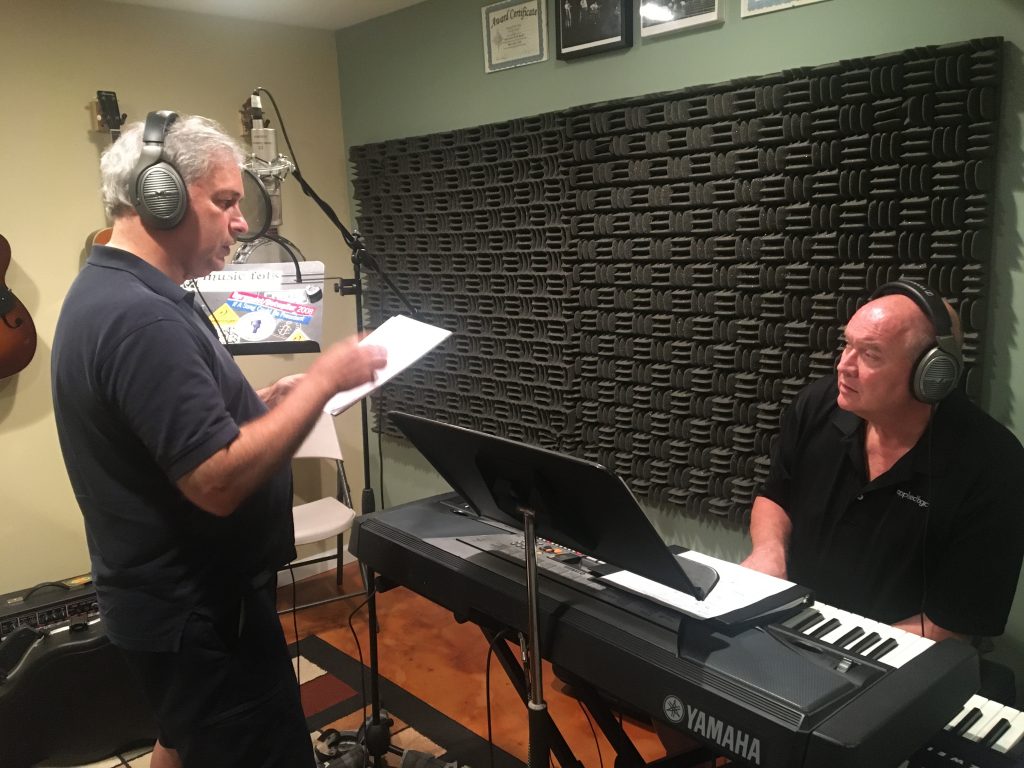
My friends and collaborators John Caravelli, left, and Phil Cooper, working out the arrangement of “It Looked Like Hope.”

“We have all been there,” writes my friend and collaborator John Caravelli. “You may call it emptiness, a dry spell or a dark night of the soul. Many of us are feeling that way right now and for good reason. We are in the midst of a deadly pandemic. This election season has been filled with uncivil discourse, reported to us incessantly via social media and a 24-hour news cycle. We are experiencing the consequences of racial divisions and climate change. Whatever the reason, we can all find ourselves feeling lost, angry or sad for periods in our lives.”  

Acknowledging all those emotions and yet holding out for something better, John wrote a song not about the darkness but the light, about what we experience when the heaviness lifts.  
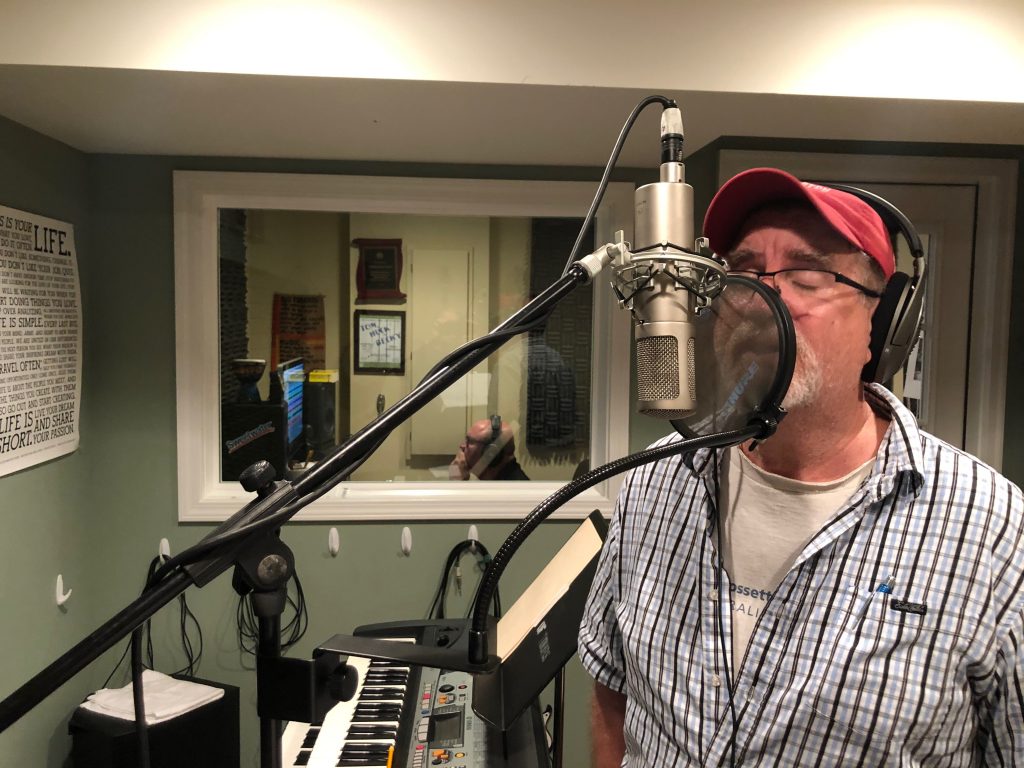
That’s me, singing. Photo by John Caravelli.

“Very often, it’s not something you can really identify, but you know when it happens,” he says.  “Suddenly, you notice more about what is right with the world and not only what is wrong. You see the beauty, the kindness, the love and the blessings. Despair gives way to hope, as it should.”

John wrote the song, “It Looked Like Hope,” about the experience of searching for hope in all the right places — in an autumn day, by the light of a full moon, in the dawning sun, in places where we might least expect to find it — and finding in those still moments not just beauty but the very face of God; of knowing, like Julian of Norwich, that “all will be well and all will be well.” That God is near, no matter how we’re feeling about it. 

John let me do the singing while he played guitar, and our friend and third collaborator in the CCG songwriting trio, Phil Cooper, played the keyboard. John and I produced the video below, and I added a quote at the end from John’s favorite saint, St. Therese of Lisieux, which seemed to sum up how we were feeling, or at least hoping:

Above the clouds, the sky is always blue.

It Looked Like Hope

It’s been a long time coming
It’s been a long time tired
I’ve been lost and angry
As if some evil fates conspired.

Dark autumn wind blew all day
There was a hunter’s moon last night
It shone through my bedroom window
My bed glowed in the Lord’s moonlight.

And when the dawning sun broke through the clouds,
From my dream as I awoke,
I believe I saw the face of God
I believe it looked like hope.

But there’s an end to every dark road
The light will shine at last
A song of hope will deliver you
From a helpless lonely past.

I believe I heard the angels sing
A pure and simple song
To relieve me of the mournful tune
I’ve been singing much too long.

And when you least expect it
In a dream that you have, in a song that you hear 
It’s then that you know 
That all will be well, and all will be well
That your God is near, that your God is near

I believe I heard the angels sing
A pure and simple song
To relieve me of this mournful tune
I’ve been singing much too long.

And when dawning sun broke through the clouds,
From my dream as I awoke,
I believe I saw the face of God
I believe it looked like hope.
I believe I saw the face of God
I believe it looked like hope.

Words and music by John Caravelli. Copyright 2020 Potter’s Mark Music.
Prayer Time: Waiting for My Return

Steve · July 2, 2020 · 10 Comments

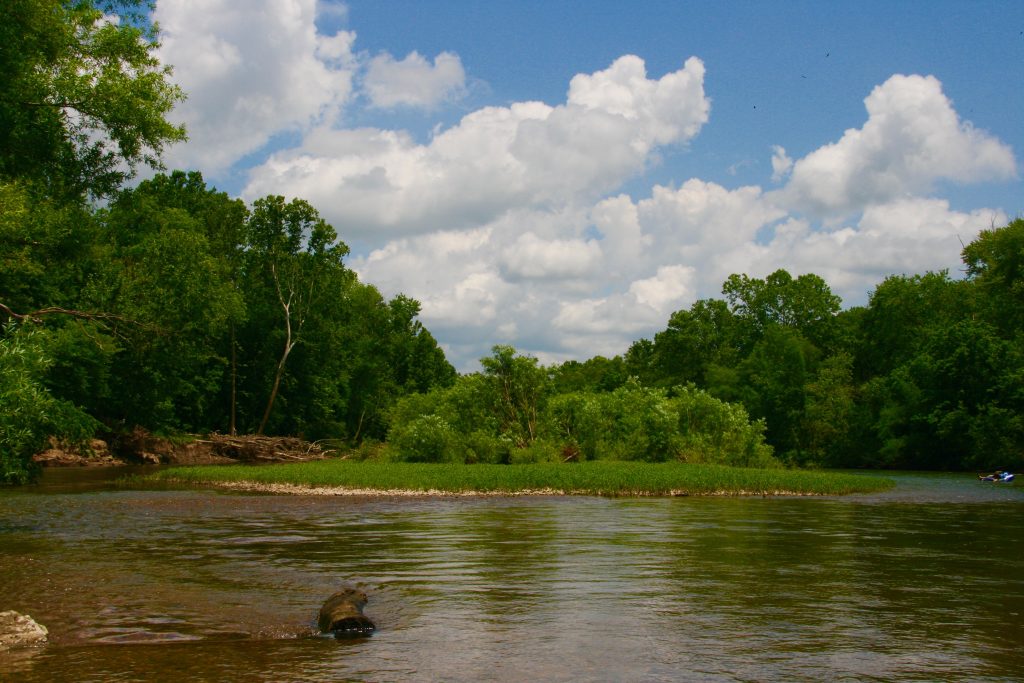
Father’s Day 2020 on the Meramec River in the northern Ozarks.

Today I awoke to a cool and refreshing morning that I know will sizzle and steam away as St. Louis-in-July heat and humidity takes hold of the rest of the day. On the back porch I watched the goldfinches visit their feeder and waited for the doe and two fawns to take their daily stroll through the property behind me.

I need this time in the morning, a time to slow and quiet down, a chance to regather my thoughts and point myself in the direction of Creator and creation. I slipped on my headphones and listened to my friend and musical collaborator Phil Cooper’s beautiful solo piano piece aptly called “Prayer Time,” composed back in 2005. I listened again and again, and the images that appeared were ones of flowing water — refreshing, cleansing, new and as ever-present and ever-changing in our lives as the great unchanging changer we call God. These lines came to me:

You are a stream running through me
flowing forth from deep within
seeping in like some ancient spring
hidden in the grass by the corner of the field.

Even in dry seasons you remain
a trickle of nourishment and hope in my dryness
never fully gone, only lost in the tall grass for a spell
still ever present and watching, waiting for my return.

The images and emotions of this running water kept coming, so I spent the rest of the morning creating the video below for Phil’s music. You need and deserve these three minutes.

Grace and peace to you. Grab some silence and solitude for yourself. God will show up.

With the Faith of a Child (with video)

Steve · June 11, 2020 · 2 Comments

Jason Parker Deffenbaugh. He smiles when I sing to him, and that can be the best part of my day.

Earlier this week, I was holding my youngest grandson, Jason. He was born prematurely back in January and weighed in at less than four pounds. Five months later, he is up over eleven pounds and doing well. As I held him, I thought about what it means to have the kind of “childlike faith” that Jesus asks of us. What does it really mean?

I don’t think it means unquestioning or naïve faith, first of all, nor does it mean blind faith that leaves no room for reason and a developed mind that questions. The faith of a child, I think, is about living in abundance and potential. It’s about trusting that we will be provided for and that from that abundance comes the belief that all things are possible through Christ.

Children believe they can accomplish anything they set their minds to because they haven’t yet been given a false sense of their own limitations. That will come soon enough. But while they are children, their “enough” is being held and fed, comforted and protected, playing and sharing and quickly forgiving, even when they don’t understand the world and all it holds.

And isn’t that the kind of faith Jesus wants us to have?

Today, I offer a new song and video created just this week with my songwriting partner and friend John Caravelli. Between us, we have eleven granddaughters, and this is a song for them, their joy, their resilience, their faith.

Songs of Comfort: On Eagle’s Wings

Steve · April 22, 2020 · 8 Comments

Note: I interviewed Fr. Jan Michael Joncas a few weeks ago about the enduring power and comfort of his song, “On Eagle’s Wings” for Catholic Digest magazine, which went out of print not long after the assignment. So with Fr. Joncas’ permission, I am posting the article here.

Fr. Jan Michael Joncas, courtesty photo.

When Fr. Jan Michael Joncas composed the song “On Eagle’s Wings” four decades ago, he was trying to comfort a friend whose father had just died of a heart attack. He wrote the song on guitar in the days following the death and then performed it at the funeral, and that might have been the end of the story. But God, Fr. Joncas said in a recent interview, had other plans.

“It’s just amazing to me,” said Joncas, 68, a prolific composer, priest of the Archdiocese of St. Paul and Minneapolis, and artist-in-residence and research fellow in Catholic Studies at St. Thomas University. “I had no way of knowing, first of all, how it got distributed so that people could use it. But by now, it’s made its way across most of the English-speaking world and into other denominational hymnals.”

Even higher-profile uses of the song include recordings by superstars like Josh Groban and Michael Crawford, as well as its performance at the memorial service for the 1995 Oklahoma City bombing victims and at the funeral of opera singer Luciano Pavarotti.


“I never expected anything like this to happen,” said Fr. Joncas, quarantined at home in St. Paul, “but as I’ve grown older, I’ve grown more and more comfortable with it. I tell my friends that to even have written one piece that has allowed this many people to sing their faith is an incredible gift. Even if nothing else I’ve written ever has that same kind of distribution or power, I’m still happy with it. God does what God wants with this stuff. I am just more and more amazed at how God can use things that you might not ever have thought of to advance whatever God’s intentions are.”

And although it’s become one of a handful of contemporary hymns that have become staples at funerals, Fr. Joncas believes its scriptural roots in Psalm 91, as well as in Exodus and the Gospel of Matthew, make it a song of comfort for the many confusing and fearful times of our lives, as well as for ordinary and joyful times like baptisms and weddings.

“I’m going to use my academic background here,” he said, laughing quietly. “It’s the multivalence [ability to have many values and meanings] of any kind of canonical text scriptures that give them really different importance or different meanings based on the context in which they are used. So the context for ‘Eagle’s Wings’ has been in most people’s experience of funerals, but it’s not limited to that.”

The fact that the song can often make people cry – not because it’s sad but because it’s so comforting — is a gift of the Spirit, said Fr. Joncas, who in 2003 was diagnosed with Guillain-Barré Syndrome, a disorder in which the body’s immune system attacks the nervous system. He was paralyzed for several years and unable to compose. He wrote about his experiences of the disease in “On Eagle’s Wings: A Journey Through Illness Toward Healing,” released in 2017 by Twenty-Third Publications. It was that experience, he says, that allowed him to move beyond his Midwestern stoicism.

“The Eastern traditions talk about the gift of tears, which I think is really accurate,” he said. “I’m a now-beyond-middle-aged, Caucasian Midwesterner, which means that expressions of deep emotion just don’t come to me naturally. After my experience with Guillain-Barré, I found that I’m much more able to trust the feelings, to let them come out, and to connect empathically with people.”

It is, perhaps, the song’s central and vivid image of being “held in the palm of his hand” that gets us every time. It’s a physical impossibility, but it’s the emotional driver of the song. And that’s the power of scripture, Fr. Joncas says.

“One of the things I teach is that psalms are the cries of the human heart, that even though these are ancient Jewish lyrics, they have this wonderful ability to enter very deeply into human experience and then allow that experience to become a way of encountering God.”

At this moment in time, when the world is wracked by disease and the fear of the unknown, Fr. Joncas suggests that leaning on ancient texts like the Psalms can be a healing salve precisely because there’s nothing new under the sun.

“Although this [pandemic] is certainly unprecedented in our memory, there are people who can point to the Spanish influenza right at the beginning of the 20th century. As a historian, I can say, ‘well, it’s not the black death where a third of Europe simply disappeared over the course of a couple of years.’ We’ve faced this kind of difficulty before. But I think the scary part is we’ve got so much good science and technology that we thought we’d be protected from anything like this. So it really pulls the rug out from underneath our expectations.

“When that happens, I think going back to texts from our heritage is important, and songs of comfort remind us of a time when we have already experienced God’s care, and it’s kind of an act of trust that God will continue to care for us.”

In the palm of his hand.


Four offerings for your Good Friday

Steve · April 10, 2020 · 3 Comments

Greetings, friends and readers. Today I offer you four resources for prayer and reflection on this Good Friday.

The first is the conclusion of my seven-part video series on the Seven Last Words of Jesus. If you missed any of them, they are all available here on my blog, of course. Today’s message is from the gospel of Luke and gives us Jesus’ last words to his father at the very moment of his death.

“Father, into your hands I commend my spirit.” Luke 23: 44-46

Next up is a short poem and image for reflection, another in the daily series I have been offering during this time of the pandemic.

Below is a new music video for an older song, composed back in 2002 with my friend and collaborator, Phil Cooper, “Consider the Nails.”

Finally, if you’re available this afternoon at 3 p.m. (Central Time), I will be presenting “Crossroads: Stations of the Cross for a Time of Change” on Facebook Live from the Marianist Retreat and Conference Center, just outside of St. Louis. If you want to join in and pray with us live (or view it afterwards at your leisure), you can find the Center’s Facebook page here:

https://www.facebook.com/retreatschangelives/

Blessed Triduum and a Happy Easter to you all!

Steve

  • « Go to Previous Page
  • Page 1
  • Page 2
  • Page 3
  • Page 4
  • Interim pages omitted …
  • Page 6
  • Go to Next Page »

Primary Sidebar

Subscribe to Our Newsletter

Check your inbox or spam folder to confirm your subscription.

Categories

  • A (Very) Short Story
  • Being There
  • Blessings
  • Book Reviews
  • Chemotherapy
  • Christmas
  • Creative Spirit
  • Creativity
  • Games We Played
  • Guest Bloggers
  • History
  • House concerts
  • Ignatian Spirituality
  • Leadership
  • Music
  • My Soundtrack
  • Nature
  • Notes from a Lecture
  • Photography
  • Poetry
  • Prayer
  • Scripture
  • Songwriters
  • Spirituality
  • Sports and Culture
  • Stem Cell Transplant
  • STLToday Faith Perspectives
  • Today's Word
  • Travel
  • Two Minutes
  • Uncategorized
  • Vocation & Call

Recent Comments

  • Steve on All Signs Point to the House of God
  • Steve on We are the Leftover Fragments
  • Chris on We are the Leftover Fragments
  • Pat Butterworth on All Signs Point to the House of God
  • Steve on Wonder as the Foundation of Prayer

About the Author

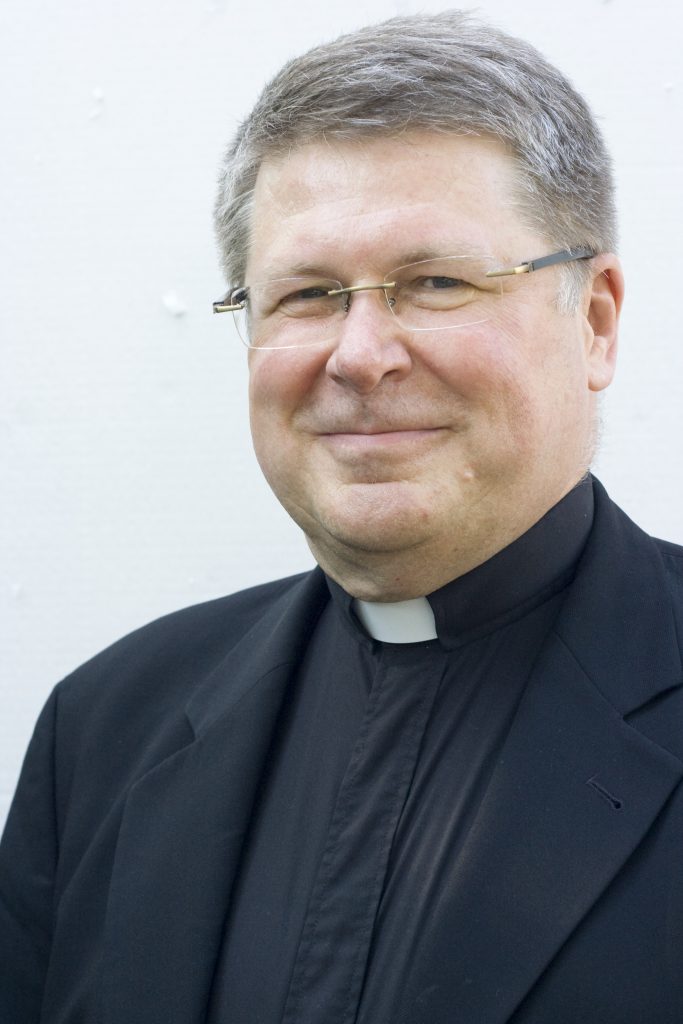
Steve Givens is a retreat and spiritual director and a widely published writer on issues of faith and spirituality. He is also a musician, composer and singer who lives in St. Louis, Mo., with his wife, Sue. They have two grown and married children and five grandchildren.

Read More >>>

Recent Posts

  • For Just One Night – Hope and Peace
  • Let’s Go Around the Table (in Detail)
  • All Signs Point to the House of God
  • Wonder as the Foundation of Prayer
  • We are the Leftover Fragments

Recent Posts

  • For Just One Night – Hope and Peace
  • Let’s Go Around the Table (in Detail)
  • All Signs Point to the House of God
  • Wonder as the Foundation of Prayer
  • We are the Leftover Fragments
  • Home
  • About
  • Blog
  • Spiritual Direction
  • Publications
  • CCG Music
  • Contact

Reach out to connect with Steve Send an E-mail

Copyright © 2026 · Built by Jon Givens · Log in