• Skip to primary navigation
  • Skip to main content
  • Skip to primary sidebar

Givens Creative

Life at the intersection of faith, nature, history and art

  • Home
  • About
  • Blog
  • Spiritual Direction
  • Publications
  • CCG Music
  • Contact
  • Show Search
Hide Search

Nature

Wonder as the Foundation of Prayer

Steve · August 31, 2025 · 3 Comments

Earlier this summer, I read the book, “Awe: The New Science of Everyday Wonder and How It Can Transform Your Life,” by Dacher Keltner, an expert on human emotion and a professor of psychology at UC-Berkeley, where he serves as the director of the university’s Greater Good Science Center. In the book, Keltner sets out to define what we mean by “awe” and illustrates the experience of awe through dozens of individual stories gathered from around the world.

And, indeed, it’s the global experience of awe that makes this book worth reading. We are all moved, he writes, by experiences that make us draw in a sharp breath and let out the slow sound of “awe” or maybe “wow” or “woah.” In this sense, in what moves us, we all speak the same language, and there is something very important about understanding that.  
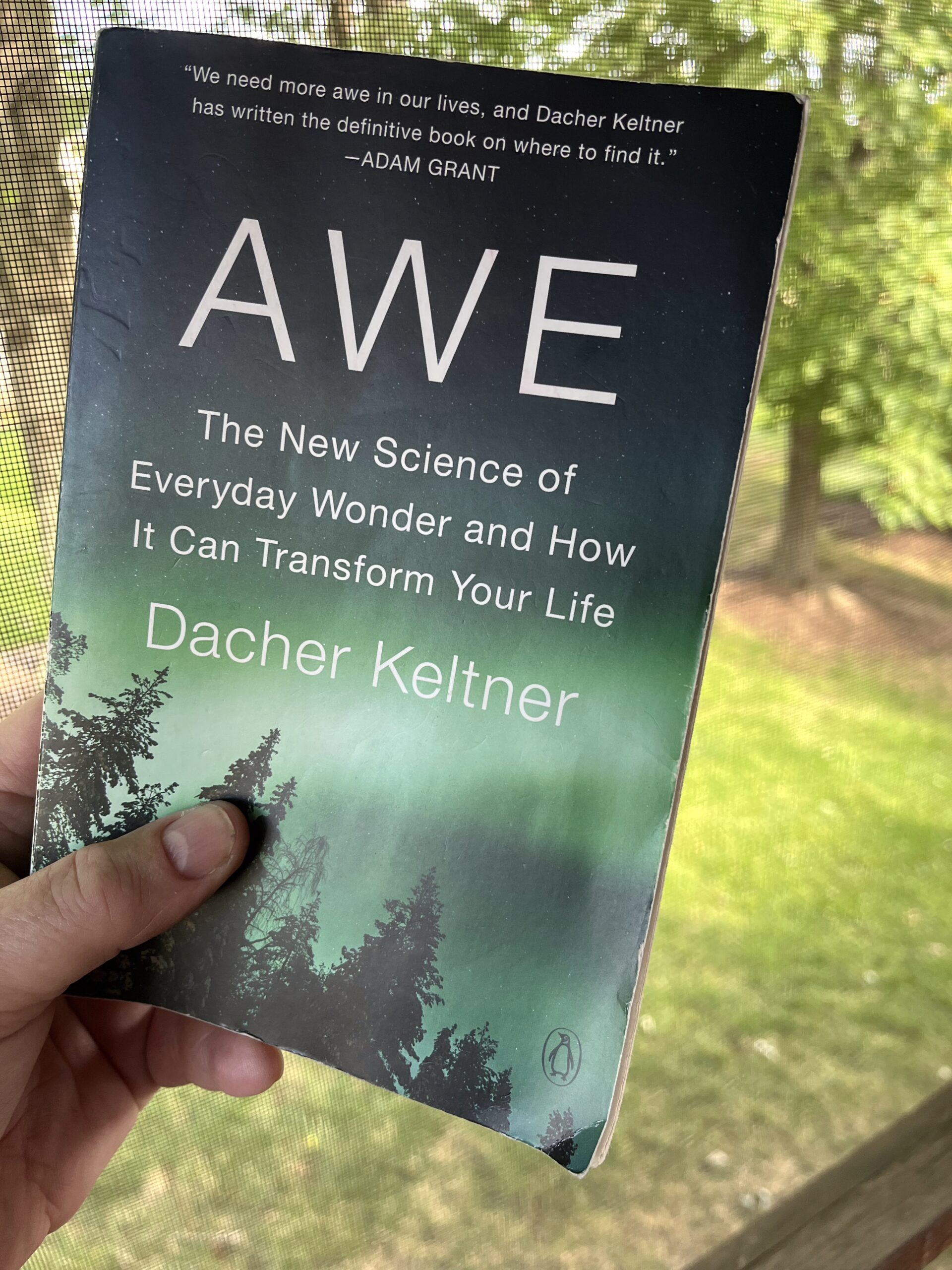
For the purpose of the book and drawn from his own deep research, Keltner defines awe as: “The feeling of being in the presence of something vast that transcends your current understanding of the world.” It is about “our relation to the vast mysteries of life.” These experiences, he writes, come from the “eight wonders of life,” which can be classified into a “taxonomy of awe.” They are, in order of their commonality around the world:

  • Moral Beauty – other people’s courage, kindness, strength and overcoming.  
  • Collective Effervescence – those moments when, as part of a crowd (whether at church or a sports stadium) we feel we are part of a collective self or tribe – an experience of “we.”
  • Nature – not surprisingly, our experience in and of nature can often leave us speechless and with a sense of “something bigger” at work.
  • Music – and its ability to transport us to “new dimensions of symbolic meaning.”
  • Visual Design – art and architecture and its power to open our minds to new ways of perceiving the world and “locate ourselves” within the cultural systems that surround us.
  • Stories of Spirituality and Religion – and the way they transform, transcend, and give us hope for something more.
  • Stories of Life and Death – are common around the world and lead to awe at such moments as first and last breaths.
  • Moments of Epiphanies – times when we suddenly understand essential truths about life and experience “philosophical insights, scientific discoveries, metaphysical ideas, personal realizations, mathematical equations, and sudden disclosures that transform life in an instant.”

While you likely won’t find Keltner’s book on the “spirituality or religion” section of your local bookstore or online category, I found it to be a great tool for my regular prayer of reflection and examination of my day – my “examen,” as it known in Ignatian spirituality. Keltner’s “eight mysteries” opened my mind to looking for and finding God in an ever-wider array of my life experiences.

Shortly after finishing the book, I began to wonder: What if I paid a little closer attention every day to what astounds me and fills me with awe and wonder? What might I see and experience each day because I am looking for the awe? What if I expanded my time of reflection to look more broadly and consider those eight areas of mystery? What if this was the way I ended each day, with this examen of awe?

At this point in time, I am two months into a project to record one such moment of awe each day. What I am finding thus far is a much wider set of experiences, all of which cause me to either catch my breath, drop me to my knees, or stand in quiet reflection and gratitude.

Here are two examples:
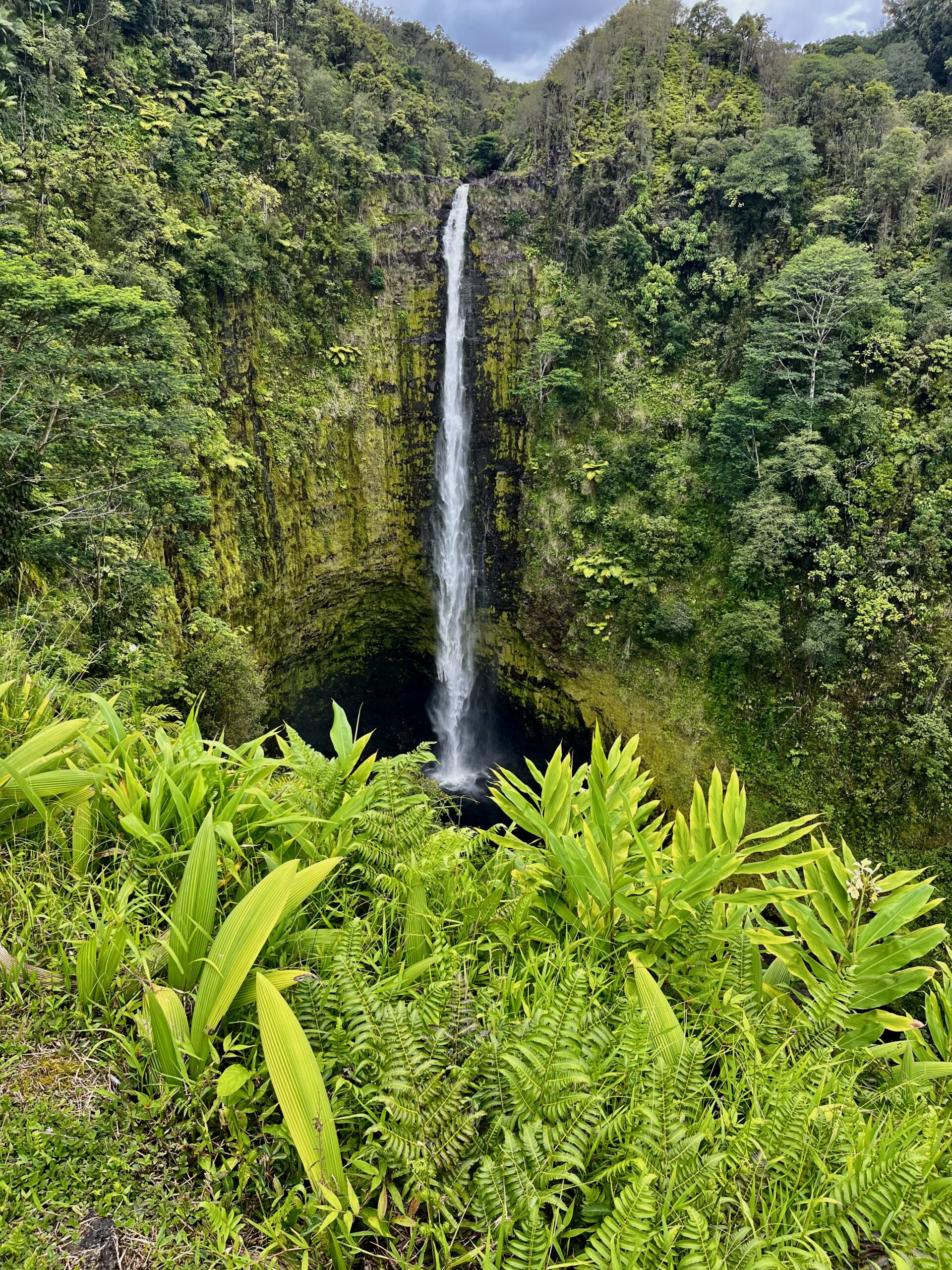
July 13 – Today Sue and I walked a half-mile loop trail that lead to the Akaka Waterfall on the east side of the Big Island of Hawai’i near Hilo. As it finally came into view, this long, 400-foot ribbon of water took my breath away — a sudden and short intake of breath that amounts to “awe.” It plunged over the edge like an Olympic diver, cutting like a knife into the pool beneath it. Perfect in form, a quiet and perfectly straight line into the folding water. And so I prayed: “Cut me like a knife, O Lord, sever me from myself to allow you in. Pierce my heart and allow me to feel the height and depth of your love and compassion for me. Fill me, just as this water continually fills the bowl that rests beneath the falls like open hands.”

August 30 – This morning we went to a funeral for our friend’s 94-year-old father. We didn’t know him or were not even sure we had ever met him. We were there because we believe it’s important to “show up” for people in their times of grief and need. We believe in the beauty and sanctity of the “last rites” of the Catholic Church, that they are fitting ways to celebrate the end of earthly existence and be present as something new begins. I was awed by the flow of music, scripture, ritual, words of remembrance, all encouraging me to consider my own life and death. With the responsorial Psalm, drawn from the oft-used 23rd Psalm, we sang: “Shepherd me, O God, beyond my wants, beyond my fears, from death into life.” And I think that this is what I want most when my time comes – for God to show up and shepherd me home, surrounded by the presence of those I knew and loved, and maybe a few others who show up to be there for my family, even if they have never met me. There’s awe in the way we humans (and the church) care for each other.

So here’s my challenge to you today: Pay attention to what catches your heart, your breath, your sense of being in the world, for God is in that moment.
BOOK REVIEW: Leah Rampy’s “Earth and Soul”

Steve · May 19, 2024 · 3 Comments

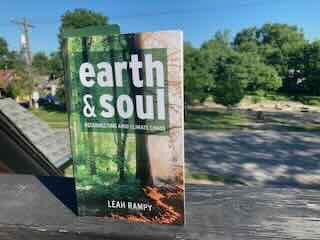
Writer and retreat leader Leah Rampy pulls no punches in her new volume from Bold Story Press, “Earth and Soul: Reconnecting Amid Climate Chaos.” The earth as we know it is in a dire predicament, from which there is no easy return or solution. We are living in “edge times,” on the threshold of climate chaos and mass extinction of biodiversity and will remain there while we await a slow slipping over the edge — unless we are willing reconnect our personal lives and our spiritual selves to the world around us.   

This is not a story devoid of hope. I doubt I would have kept reading if it were. If we’re willing to face the scientific facts of the situation, see more completely the fullness and wisdom of the world around us, and embrace the spiritual angst we are feeling, there is still the possibility of pulling ourselves back from the brink. “Earth and Soul” is a soul journey (the author’s and ultimately our own) that still has inherent in it the hope of something better beyond the grief that comes with such danger and loss. In the book’s concluding chapter she writes:

Because we will never know the outcomes beyond our lifetime, we can choose to live in a story that is grounded in the real and that still offers greater possibility. Living with hope is a choice. When we choose hope, we embrace what is already unfolding and discern if and how we are called to respond. Without any illusion that the path will be easy, we choose to live more fully into our soul’s mission and offer our gifts to the world guided by the Earth’s wisdom.

Writing while standing near the intersection of spirituality, ecology and story, the author offers us a chance to journey in the direction of recovery and sanity, a map of sorts for those willing to live deeply connected to the Earth from the depth of their own souls. For the climate crisis is, she reminds us, a spiritual one. “Without attending to our own continued transformation, we cannot hope to align with the living world to create a tapestry of a beautiful future,” she writes in the book’s introduction.

The eleven short chapters in this 200-page paperback edition made for easy, slow and digestible daily reading for a few weeks. While I could have read it much quickly (it’s not a dense slog through theory and environmental science), I soon discovered that this was a book better taken in a little at a time, a reminder to myself that this kind of change (our own and the environment’s) takes time and trust, a belief that the seeming impossible is, in fact, possible. Drawing from Jesuit theologian Walter’s Burghardt’s reminder that contemplation is a, “long, loving look at the real,” this book is a call to ponder the predicament as a precursor to individual and spiritual change and action.

What is necessary for such change to begin, Rampy reminds us, is personal transformation, a movement from long-held social beliefs that the Earth and its non-human creatures are only here for our sustenance, use and often abuse, to a state of recognition that we are better off living in communion with our plant and animal “kith and kin.”

“When we declare the land inanimate,” she writes, “we ravage our souls. If we deny the vibrantly alive Earth, the breathing beings from which we evolved, the plants with all their gifts — if all those lives can be deemed resources to be pillaged, destroyed, discarded, and annihilated to satisfy our wants — then so too can people who stand in the way of achieving the ends we seek.”

“Earth and Soul” is an invitation to think, live, contemplate and act differently, as if those human actions might just make a difference, which surely they can. This book, Rampy writes, serves as “one invitation to a great turning, a return to our truest selves and a transformation of our relationship with the Earth.”

To instigate such changes, we must begin now, while we are still on the threshold, but Rampy is quick to point out that this is the work of generations, not years or decades. She relates the story of a wise prophet giving feedback to a group of volunteers who had taken some positive steps. “I think this is very good,” the prophet says. “There will likely be excellent results from this in about six hundred years.”

And that’s the point of the book, I think. There are no easy and quick answers. There are only next steps that must be taken, once we have done the hard work of reconnecting our souls to the world around us. She writes: “We will need to practice simply discerning the next step, and then the next step, and then the next, trusting the wisdom we are given without knowing the future or the results of our efforts.”

Right in Front of Our Eyes

Steve · July 6, 2023 · 8 Comments

Once when I was a boy I was trying to find something — I don’t remember now what it was — but this thing ended up being right there on the table in front of me. My father laughed as he pointed it out to me and said, “If it had been a snake, it would have bitten you.”

As a child, that metaphor scared me a little. What IF it had been a snake? What IF I hadn’t seen it there on the table, hiding among my father’s copies of National Geographic and Organic Gardening, slithering toward me between his overflowing ashtray and transistor radio? I learned to look closely around me for the things I was searching for before I started asking for help. Lesson learned: pay attention to the obvious and the close at hand.

In our search for God, sometimes the same thing happens. We miss the obvious moments and occurrences of the Divine because we’re frantically searching for something “out there,” something that is big and splashy and without-a-doubt “God,” when all the time there are these small, ordinary experiences that we’re missing, hidden among the ordinary stuff of life.

Finding God in our daily lives does not require special abilities or tools. We do not have to be particularly holy, although focusing our minds on the holy around us can be a good place to begin. What is required is our intention — a desire and willingness to pay attention to the life we have been given and find God already there waiting for us, beckoning to us, laughing at us and saying, “If I had been a snake…”

I recently wrote a new song on this theme, this idea that God is “right there,” always in front of our eyes. God doesn’t hide from us. God is always waiting to be found, always delighted when we slow down, pay attention and utter those sacred words: “Ah…there you are.”

Here are the lyrics to the song, and a new video is below (you may have to scroll a little). Thanks to my musical collaborator Phil Cooper for the beautiful piano arrangement and to my talented daughter, Jenny, for creating the vocal arrangement and singing with me. In the midst of the creation of this song I found God again — in the act of creation, in the gift of words and music, in the chemistry that happens when we gather together to create something new.

There you are, there you are
in the green that clothes the trees
There you are, there you are
in the very least of these.

Some days I rise but do not waken.
Sometimes I look but fail to see.
And still, you move and catch my eye
A flash of red, a moment fleeting.

In all the noise I cannot hear you.
In all my words I miss your voice.
And still, a whisper fills my head
A gentle beating, inside of me.

Today I saw you on the street
With all you own spread out around you.
And still, a spirit in your smile
A soul on fire, a gift before me.

There You Are
Words and music by Steve Givens
© 2023 Potter’s Mark Music

The Seeds of My Father’s Garden

Steve · January 14, 2023 · 26 Comments


“But some seed fell on rich soil, and produced fruit, a hundred or sixty or thirtyfold. Whoever has ears ought to hear.” (Matthew 13:9)

My father’s garden wasn’t much by the standards of many gardens. It was situated on a small plot of land in the backyard of my North St. Louis home in the 1960s and early ‘70s, planted with love, passion and knowledge gleaned from the pages of Organic Gardening magazine.

It sat at the back of the yard, near the alley, and I can still picture its layout in my mind’s eye, row by row. Onions against the fence, followed by lettuce and cabbage, tomatoes and green peppers, beans growing up the legs of my no-longer-used and rusting swing set, carrots, radishes, and no doubt a few others I can no longer remember. 

All organic, and all planted with the knowledge that the soil was (or could be) naturally fertile and ready to accept the seeds or the young seedlings that my father started in our basement during winter under fluorescent lights. If it sounds like I appreciated all his effort and creativity, I didn’t. Not at the time, anyway. I was a kid and saw it as largely wasted space where I couldn’t play ball and poor use of a swing set, even if I didn’t use it all that much anymore. I was told, in so many ways, to keep out. 

All these years later, I have a more mature view of what he was trying to do. He was giving us healthy, organic food free of pesticides and herbicides. He was helping us get by on a mailman’s salary and trying to teach us something we could take into adulthood with us. He was giving us something extraordinary amid the ordinary of an urban backyard. He was doing all this to tell us he loved us, even if he could never muster those words.

More than anything, I think he was seeking quiet, sacred moments with himself and God. He was trying to make sense of his father’s suicide (unknown to us kids at the time). He was silently grappling with own failed professional career as a chiropractor and perhaps wrestling with the oncoming darkness of depression and alcoholism.He was searching for something sacred in an ordinary garden. What I thought was wasted space he knew was holy ground.

We are called to prepare our hearts for the coming of the Word of God into our lives of faith like my father organically prepared the soil of his garden. The Word is planted in us already if we can just stir up the earth a little and add a little compost. The incarnation of Christ is not just about Christmas. It’s about the continual coming and planting of the Word into our lives today. It’s about seeking the extraordinary in the midst of the ordinary.

We need the Incarnated Jesus. We need a walking, breathing, working-with-us Jesus. Otherwise, he remains a word on a page of old parchment, an unfulfilled promise, an old story that’s nice to listen to but never quite seems real. A scattered seed that was planted long ago but never really took root and grew and bore fruit.

In contemplating the Incarnation during these post-Christmas, cold and often-dark days of a Midwest winter, I come to see and appreciate how our human and earthly nature is quickened and sparked by the Divine, just as life begins to grow in the dark of the soil. Even in the depth of winter, we can begin to see life through that spring lens. We can see we are the soil where the Word of God grows and, over time, we can learn to recognize the holy when God puts it right before our eyes.  

A Post-Thanksgiving Call to Awareness and Gratitude

Steve · November 26, 2022 · 2 Comments

Dear friends, 

On this ordinary day just a few days past the American holiday of Thanksgiving, I write to share a reminder (in words and in the video below) that faith requires an ongoing commitment to this idea of Thanksgiving — to awareness and living with our eyes wide open to our blessings. Above all, to gratitude. 

We are called to recognize the holy when God puts it right before our eyes. It should be our life’s work to pay attention. I’m reminded of the words of Elizabeth Barrett Browning: 

Earth’s crammed with heaven,
And every common bush afire with God,
But only he who sees takes off his shoes;
The rest sit round and pluck blackberries.

God says to us: “Listen carefully. Become more aware of the world around you, of the people and circumstances and challenges that I place in your lives. I will meet you there in these ordinary things and then I will make the ordinary extraordinary for you. I will change you.”

Below is new video (created yesterday) of an older song by me and my colleague Phil Cooper. Enjoy. 

  • Page 1
  • Page 2
  • Page 3
  • Interim pages omitted …
  • Page 12
  • Go to Next Page »

Primary Sidebar

Subscribe to Our Newsletter

Check your inbox or spam folder to confirm your subscription.

Categories

  • A (Very) Short Story
  • Being There
  • Blessings
  • Book Reviews
  • Chemotherapy
  • Christmas
  • Creative Spirit
  • Creativity
  • Games We Played
  • Guest Bloggers
  • History
  • House concerts
  • Ignatian Spirituality
  • Leadership
  • Music
  • My Soundtrack
  • Nature
  • Notes from a Lecture
  • Photography
  • Poetry
  • Prayer
  • Scripture
  • Songwriters
  • Spirituality
  • Sports and Culture
  • Stem Cell Transplant
  • STLToday Faith Perspectives
  • Today's Word
  • Travel
  • Two Minutes
  • Uncategorized
  • Vocation & Call

Recent Comments

  • Steve on All Signs Point to the House of God
  • Steve on We are the Leftover Fragments
  • Chris on We are the Leftover Fragments
  • Pat Butterworth on All Signs Point to the House of God
  • Steve on Wonder as the Foundation of Prayer

About the Author

Steve Givens is a retreat and spiritual director and a widely published writer on issues of faith and spirituality. He is also a musician, composer and singer who lives in St. Louis, Mo., with his wife, Sue. They have two grown and married children and five grandchildren.

Read More >>>

Recent Posts

  • For Just One Night – Hope and Peace
  • Let’s Go Around the Table (in Detail)
  • All Signs Point to the House of God
  • Wonder as the Foundation of Prayer
  • We are the Leftover Fragments

Recent Posts

  • For Just One Night – Hope and Peace
  • Let’s Go Around the Table (in Detail)
  • All Signs Point to the House of God
  • Wonder as the Foundation of Prayer
  • We are the Leftover Fragments
  • Home
  • About
  • Blog
  • Spiritual Direction
  • Publications
  • CCG Music
  • Contact

Reach out to connect with Steve Send an E-mail

Copyright © 2026 · Built by Jon Givens · Log in