• Skip to primary navigation
  • Skip to main content
  • Skip to primary sidebar

Givens Creative

Life at the intersection of faith, nature, history and art

  • Home
  • About
  • Blog
  • Spiritual Direction
  • Publications
  • CCG Music
  • Contact
  • Show Search
Hide Search

Book Reviews

Wonder as the Foundation of Prayer

Steve · August 31, 2025 · 3 Comments

Earlier this summer, I read the book, “Awe: The New Science of Everyday Wonder and How It Can Transform Your Life,” by Dacher Keltner, an expert on human emotion and a professor of psychology at UC-Berkeley, where he serves as the director of the university’s Greater Good Science Center. In the book, Keltner sets out to define what we mean by “awe” and illustrates the experience of awe through dozens of individual stories gathered from around the world.

And, indeed, it’s the global experience of awe that makes this book worth reading. We are all moved, he writes, by experiences that make us draw in a sharp breath and let out the slow sound of “awe” or maybe “wow” or “woah.” In this sense, in what moves us, we all speak the same language, and there is something very important about understanding that.  
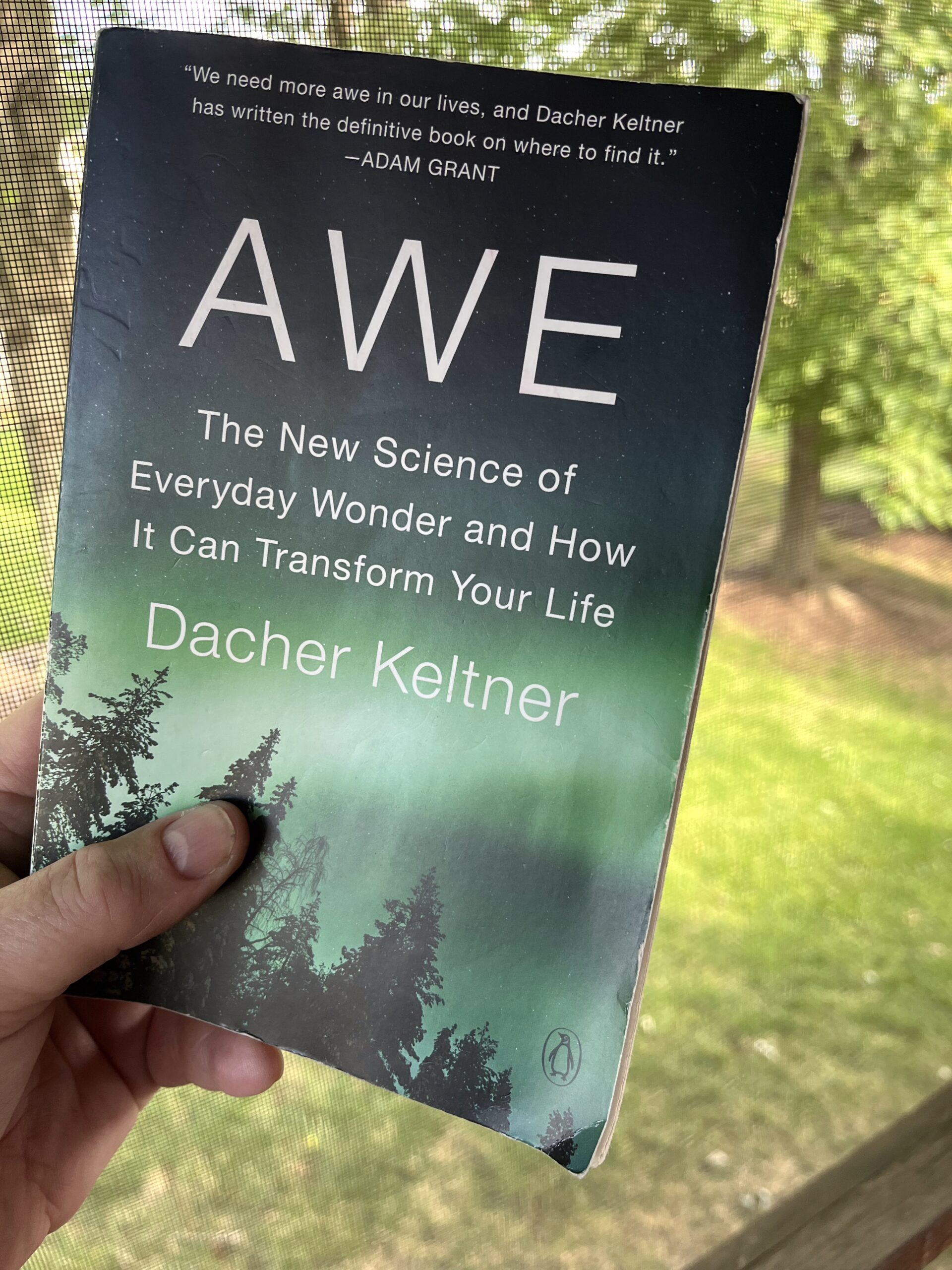
For the purpose of the book and drawn from his own deep research, Keltner defines awe as: “The feeling of being in the presence of something vast that transcends your current understanding of the world.” It is about “our relation to the vast mysteries of life.” These experiences, he writes, come from the “eight wonders of life,” which can be classified into a “taxonomy of awe.” They are, in order of their commonality around the world:

  • Moral Beauty – other people’s courage, kindness, strength and overcoming.  
  • Collective Effervescence – those moments when, as part of a crowd (whether at church or a sports stadium) we feel we are part of a collective self or tribe – an experience of “we.”
  • Nature – not surprisingly, our experience in and of nature can often leave us speechless and with a sense of “something bigger” at work.
  • Music – and its ability to transport us to “new dimensions of symbolic meaning.”
  • Visual Design – art and architecture and its power to open our minds to new ways of perceiving the world and “locate ourselves” within the cultural systems that surround us.
  • Stories of Spirituality and Religion – and the way they transform, transcend, and give us hope for something more.
  • Stories of Life and Death – are common around the world and lead to awe at such moments as first and last breaths.
  • Moments of Epiphanies – times when we suddenly understand essential truths about life and experience “philosophical insights, scientific discoveries, metaphysical ideas, personal realizations, mathematical equations, and sudden disclosures that transform life in an instant.”

While you likely won’t find Keltner’s book on the “spirituality or religion” section of your local bookstore or online category, I found it to be a great tool for my regular prayer of reflection and examination of my day – my “examen,” as it known in Ignatian spirituality. Keltner’s “eight mysteries” opened my mind to looking for and finding God in an ever-wider array of my life experiences.

Shortly after finishing the book, I began to wonder: What if I paid a little closer attention every day to what astounds me and fills me with awe and wonder? What might I see and experience each day because I am looking for the awe? What if I expanded my time of reflection to look more broadly and consider those eight areas of mystery? What if this was the way I ended each day, with this examen of awe?

At this point in time, I am two months into a project to record one such moment of awe each day. What I am finding thus far is a much wider set of experiences, all of which cause me to either catch my breath, drop me to my knees, or stand in quiet reflection and gratitude.

Here are two examples:
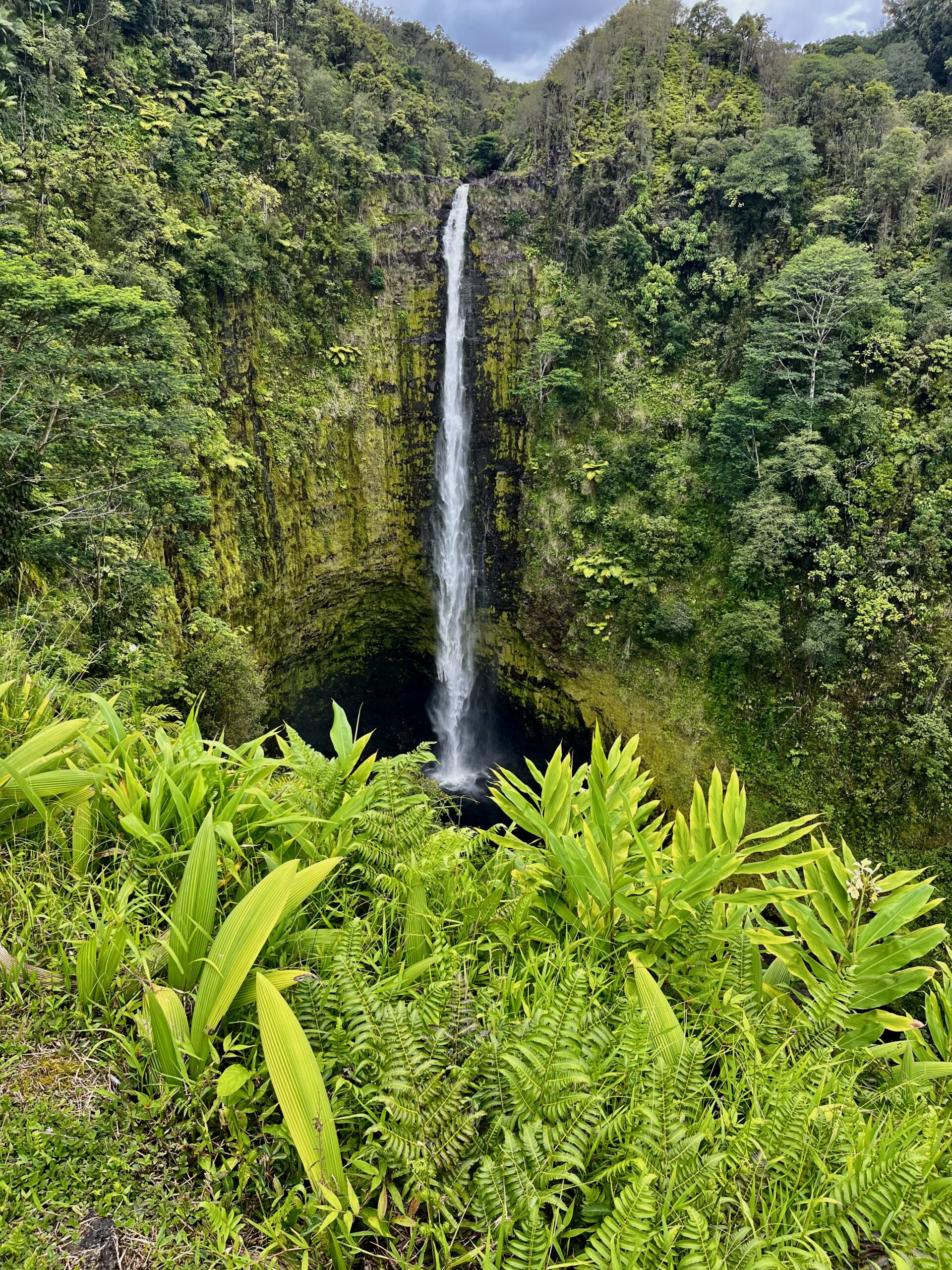
July 13 – Today Sue and I walked a half-mile loop trail that lead to the Akaka Waterfall on the east side of the Big Island of Hawai’i near Hilo. As it finally came into view, this long, 400-foot ribbon of water took my breath away — a sudden and short intake of breath that amounts to “awe.” It plunged over the edge like an Olympic diver, cutting like a knife into the pool beneath it. Perfect in form, a quiet and perfectly straight line into the folding water. And so I prayed: “Cut me like a knife, O Lord, sever me from myself to allow you in. Pierce my heart and allow me to feel the height and depth of your love and compassion for me. Fill me, just as this water continually fills the bowl that rests beneath the falls like open hands.”

August 30 – This morning we went to a funeral for our friend’s 94-year-old father. We didn’t know him or were not even sure we had ever met him. We were there because we believe it’s important to “show up” for people in their times of grief and need. We believe in the beauty and sanctity of the “last rites” of the Catholic Church, that they are fitting ways to celebrate the end of earthly existence and be present as something new begins. I was awed by the flow of music, scripture, ritual, words of remembrance, all encouraging me to consider my own life and death. With the responsorial Psalm, drawn from the oft-used 23rd Psalm, we sang: “Shepherd me, O God, beyond my wants, beyond my fears, from death into life.” And I think that this is what I want most when my time comes – for God to show up and shepherd me home, surrounded by the presence of those I knew and loved, and maybe a few others who show up to be there for my family, even if they have never met me. There’s awe in the way we humans (and the church) care for each other.

So here’s my challenge to you today: Pay attention to what catches your heart, your breath, your sense of being in the world, for God is in that moment.
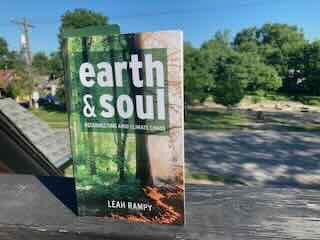
BOOK REVIEW: Leah Rampy’s “Earth and Soul”

Steve · May 19, 2024 · 3 Comments

Writer and retreat leader Leah Rampy pulls no punches in her new volume from Bold Story Press, “Earth and Soul: Reconnecting Amid Climate Chaos.” The earth as we know it is in a dire predicament, from which there is no easy return or solution. We are living in “edge times,” on the threshold of climate chaos and mass extinction of biodiversity and will remain there while we await a slow slipping over the edge — unless we are willing reconnect our personal lives and our spiritual selves to the world around us.   

This is not a story devoid of hope. I doubt I would have kept reading if it were. If we’re willing to face the scientific facts of the situation, see more completely the fullness and wisdom of the world around us, and embrace the spiritual angst we are feeling, there is still the possibility of pulling ourselves back from the brink. “Earth and Soul” is a soul journey (the author’s and ultimately our own) that still has inherent in it the hope of something better beyond the grief that comes with such danger and loss. In the book’s concluding chapter she writes:

Because we will never know the outcomes beyond our lifetime, we can choose to live in a story that is grounded in the real and that still offers greater possibility. Living with hope is a choice. When we choose hope, we embrace what is already unfolding and discern if and how we are called to respond. Without any illusion that the path will be easy, we choose to live more fully into our soul’s mission and offer our gifts to the world guided by the Earth’s wisdom.

Writing while standing near the intersection of spirituality, ecology and story, the author offers us a chance to journey in the direction of recovery and sanity, a map of sorts for those willing to live deeply connected to the Earth from the depth of their own souls. For the climate crisis is, she reminds us, a spiritual one. “Without attending to our own continued transformation, we cannot hope to align with the living world to create a tapestry of a beautiful future,” she writes in the book’s introduction.

The eleven short chapters in this 200-page paperback edition made for easy, slow and digestible daily reading for a few weeks. While I could have read it much quickly (it’s not a dense slog through theory and environmental science), I soon discovered that this was a book better taken in a little at a time, a reminder to myself that this kind of change (our own and the environment’s) takes time and trust, a belief that the seeming impossible is, in fact, possible. Drawing from Jesuit theologian Walter’s Burghardt’s reminder that contemplation is a, “long, loving look at the real,” this book is a call to ponder the predicament as a precursor to individual and spiritual change and action.

What is necessary for such change to begin, Rampy reminds us, is personal transformation, a movement from long-held social beliefs that the Earth and its non-human creatures are only here for our sustenance, use and often abuse, to a state of recognition that we are better off living in communion with our plant and animal “kith and kin.”

“When we declare the land inanimate,” she writes, “we ravage our souls. If we deny the vibrantly alive Earth, the breathing beings from which we evolved, the plants with all their gifts — if all those lives can be deemed resources to be pillaged, destroyed, discarded, and annihilated to satisfy our wants — then so too can people who stand in the way of achieving the ends we seek.”

“Earth and Soul” is an invitation to think, live, contemplate and act differently, as if those human actions might just make a difference, which surely they can. This book, Rampy writes, serves as “one invitation to a great turning, a return to our truest selves and a transformation of our relationship with the Earth.”

To instigate such changes, we must begin now, while we are still on the threshold, but Rampy is quick to point out that this is the work of generations, not years or decades. She relates the story of a wise prophet giving feedback to a group of volunteers who had taken some positive steps. “I think this is very good,” the prophet says. “There will likely be excellent results from this in about six hundred years.”

And that’s the point of the book, I think. There are no easy and quick answers. There are only next steps that must be taken, once we have done the hard work of reconnecting our souls to the world around us. She writes: “We will need to practice simply discerning the next step, and then the next step, and then the next, trusting the wisdom we are given without knowing the future or the results of our efforts.”

Book Review: “What Matters Most and Why: Living the Spirituality of St. Ignatius Loyola,” by Jim Manney

Steve · February 12, 2023 · 2 Comments

Whether you’re an experienced and seasoned practitioner of Ignatian spirituality or a seeker looking for new ways to put your faith into practice, Jim Manney’s new book of daily “actionables” is going to be a welcome addition to your nightstand or prayer space. 

Manney, a former editor at Loyola Press and author of many books on Ignatian spirituality, including “Ignatian Spirituality A to Z,” “What Do You Really Want?” and his popular work on the Examen, “A Simple, Life-Changing Prayer,” has organized this collection of 365 daily reflections around a traditional Ignatian approach to learning and spiritual development that includes experience, reflection, and action. 

The book from New World Library offers readers a daily dose of wisdom from established writers — from historical and contemporary Jesuit writers and thinkers to the Dalai Lama and Nelson Mandela to Buddhist, Hindu and Jewish texts — in addition to Manney’s own insightful commentary and calls to action. “What Matters Most and Why” is designed as a tool to help readers/prayers find additional depth and awareness during their times of daily prayer, as added inspiration for going deeper and wider in the awareness and gratitude that naturally spring from the daily examen of consciousness. 

As author Chris Lowney writes in the book’s foreword, Ignatian spirituality is a “superb technology, ideal for navigating today’s complex, volatile world.” The wisdom and approaches to prayer and life found in Ignatius of Loyola’s Spiritual Exercises are now 500 years old and yet retain a contemporary freshness, depth and applicability missing from much of today’s self-help philosophies. What Manney has given the world with this new volume is an easy-to-read and apply daily guide to the ancient wisdom of St. Ignatius and those who have followed in his footsteps. He does so with a clarity and conciseness that make this daily guide indispensable reading for mature Christians seeking inspiration to take their spiritual lives to both a higher and deeper level. 

For more information or to order, visit: https://www.jimmanneybooks.com.

Finding God in All Things: 10 Books for 2018

Steve · January 15, 2018 · 5 Comments

Ten Books for Finding God in All Things

From time to time, as both a writer and a spiritual director, I get asked for book recommendations. So on this cold and snowy Dr. Martin Luther King Jr. Holiday in the U.S., I stayed inside and scoured my shelves for ten books I would highly recommend, books that are both well-read and well-loved, books that have pointed me in different ways to the movement of God in my life, inspired me by their beauty and story, or have somehow appeared in my life just when I needed them most.

[Read more…] about Finding God in All Things: 10 Books for 2018

Book Review: One young Jesuit’s journey along “A Purposeful Path”

Steve · August 27, 2015 · 2 Comments

A Purposeful Path: How Far Can You Go with $30, a Bus Ticket and a Dream?
Casey Beaumier, SJ
Loyola Press, 2015

The answer to the question in the title, first of all, is “pretty far, and the journey’s more important than the destination.” And that’s almost always true in life, yes?

Beaumier’s book is a brief memoir of his 1994 Jesuit pilgrimage, an experiment each young Jesuit novice undertakes, during which time he is sent out from his community with only $30 and a one-way bus ticket. The purpose? He must survive by begging, and the point of the experiment, he writes, is to “receive a very special grace of profound trust that the Father will always provide, precisely through the kindness and generosity of other people.”

I had never heard of this pilgrimage until a few years ago when I met a couple of novices in a class I was taking at Aquinas Institute of Theology, and I’ve been intrigued by the notion ever since. So I opened the book with curiosity and wondered what it might have to teach a 55-year-old lay spiritual director and writer. The answer I received was, “a lot,” and so I highly recommend the book to anyone looking for reassurance about his or her own life journeys. We are, after all, all pilgrims.

Casey Beaumier, SJ

Beaumier’s journey, fueled by a desire to meet famed writer and teacher Maya Angelou, takes him from St. Paul, Minnesota, to the Appalachian Trail, on to Wake Forest University in Winston-Salem, North Carolina, and then to Washington, DC, and New York City and finally to New Orleans.  Along the way he learns important lessons from both likely and unlikely mentors, including from Fr. Henry Hasking, SJ, who gives him this sage advice on the meaning and purpose of the generosity of others. He tells Beaumier: “You need the courage to ask for what you need in life, and that starts by believing that you are worthy of what it is that you seek. If you weren’t, then you wouldn’t even think of asking for it. Everything is here to help you on the journey. That’s God’s design and plan.”

Reading this, I thought of how many times I felt that I wasn’t worthy to ask God for what I desired, and I recalled many times when those I was directing felt exactly the same. So this is wonderful advice for all of our journeys.

Later, kneeling before an altar as another priest prayed for and with him for the success of his journey, he receives these simple and perfect words of truth: “Be kind. Be kind. Be kind. Remember to be kind to people. Don’t forget to be kind.”

And all the people said, “Amen.” Whatever we do and wherever we go, let us remember to begin and end our days with kindness. The rest will fall into place.

Beaumier receives many good lessons along the way and has numerous encounters with kindness and grace received from God and others. But the hanging question, you are likely asking is, “Did he ever meet Angelou?” Ah, that’s the question. I could tell you the answer but it just wouldn’t be fair to you or the author. Buy the book, for it’s worth the answer. I can only say, please don’t stop before reading the afterword. Like the rest of the book, it’s a story of pure, unexpected thanksgiving, a celebration of grace and the kindness of strangers who are open to becoming friends.

  • Page 1
  • Page 2
  • Go to Next Page »

Primary Sidebar

Subscribe to Our Newsletter

Check your inbox or spam folder to confirm your subscription.

Categories

  • A (Very) Short Story
  • Being There
  • Blessings
  • Book Reviews
  • Chemotherapy
  • Christmas
  • Creative Spirit
  • Creativity
  • Games We Played
  • Guest Bloggers
  • History
  • House concerts
  • Ignatian Spirituality
  • Leadership
  • Music
  • My Soundtrack
  • Nature
  • Notes from a Lecture
  • Photography
  • Poetry
  • Prayer
  • Scripture
  • Songwriters
  • Spirituality
  • Sports and Culture
  • Stem Cell Transplant
  • STLToday Faith Perspectives
  • Today's Word
  • Travel
  • Two Minutes
  • Uncategorized
  • Vocation & Call

Recent Comments

  • Steve on All Signs Point to the House of God
  • Steve on We are the Leftover Fragments
  • Chris on We are the Leftover Fragments
  • Pat Butterworth on All Signs Point to the House of God
  • Steve on Wonder as the Foundation of Prayer

About the Author

Steve Givens is a retreat and spiritual director and a widely published writer on issues of faith and spirituality. He is also a musician, composer and singer who lives in St. Louis, Mo., with his wife, Sue. They have two grown and married children and five grandchildren.

Read More >>>

Recent Posts

  • For Just One Night – Hope and Peace
  • Let’s Go Around the Table (in Detail)
  • All Signs Point to the House of God
  • Wonder as the Foundation of Prayer
  • We are the Leftover Fragments

Recent Posts

  • For Just One Night – Hope and Peace
  • Let’s Go Around the Table (in Detail)
  • All Signs Point to the House of God
  • Wonder as the Foundation of Prayer
  • We are the Leftover Fragments
  • Home
  • About
  • Blog
  • Spiritual Direction
  • Publications
  • CCG Music
  • Contact

Reach out to connect with Steve Send an E-mail

Copyright © 2026 · Built by Jon Givens · Log in