Patience: Treasuring the Ground on Which We Stand

Patience is not a waiting passivity until someone else does something. Patience asks us to live the moment to the fullest, to be completely present to the moment, to taste the here and now, to be where we are. When we are impatient we try to get away from where we are. We behave as if the real thing will happen tomorrow, later and somewhere else. Let’s be patient and trust that the treasure we look for is hidden in the ground on which we stand.

- Henri Nouwen

Sundial at Jewel Box, Forest Park in St. Louis (photo by Steve Givens)

So often over the years I have found myself the impatient person described above, especially when it comes to waiting for God to act. I wanted to believe that the “real thing,” the better thing, my true purpose, was always just around the corner, just over the horizon, just about to happen.

I think the most fervent and continuously prayed prayer of my adult life has been some version of this: “Show me your will for my life, God, and I’ll go do it. Just show me. Make it clear.” And then I would add parenthetically: “It would be nice if you would do that soon, please. But not TOO soon because I still have this and this and this to take care of…”

Read the rest of Patience: Treasuring the Ground on Which We Stand »

Why Do You Seek the Living Among the Dead?

Christian Brothers Cemetery at LaSalle, Glencoe, Mo.

Walking through cemeteries, I have learned over the years, is a lesson in awareness. We are reminded, of course, that we are dust and to dust we shall return. But we also learn the power of quiet, of stillness, of non-busyness. It’s hard to hurry through a graveyard, and why would we want to? If we’re in a cemetery that bears the remains of our own ancestors, we become perhaps all the more acutely aware that we are not alone, that our little, short lives are not the be-all and end-all, that we are a flash in the pan of the flintlock rifle of human existence. We are merely a thread in the larger strand of life that includes the fibers of so many other lives.

Read the rest of Why Do You Seek the Living Among the Dead? »

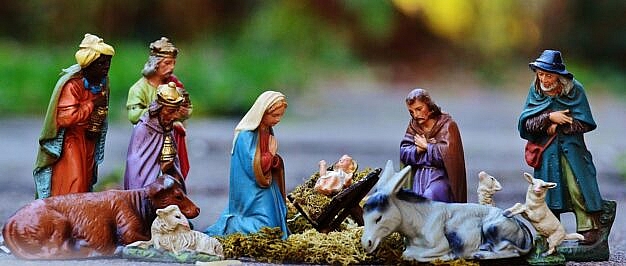
Both Here and There

MIssion Churchyard Cross, Steve Givens 2010.

He was but two,

the age they call “terrible,”

the age that elicits terrible questions too.

He stood at the crib at the church’s entrance;

he glanced up at the cross in the church’s sanctuary.

Then Aidan asked his mother,

“How can Jesus be both here and there?”

from “Aidan’s Question” by Bishop Robert Morneau, A Splash of Sunshine and Other Glimpses of Grace, Orbis Books, 2011.

Aidan’s question resonates deeply in me in these days leading up to Christmas. For especially now we Christians face this great, painful and glorious paradox of the wood – the wood of the stable and the wood of the cross. Back in my undergraduate days, I wrote this (very) short poem:

Read the rest of Both Here and There »

Onlookers and faces in the crowd

Look him in the eyes.

They are the faces in the crowd, some standing on tiptoe to get a glimpse of this condemned prophet or rabble-rouser, take your pick, as he stands mute before the authorities, as he flinches but never complains against the searing heat of the lashes, as he bears the weight of the beam across his shoulder blades and feels the bite of the sheer mass and the splintered wood.

Read the rest of Onlookers and faces in the crowd »

On the Road: To stand and receive where JFK was laid

The next in an occasional series of travelogue/photo essays on seeing and experiencing intersections of faith, history and culture — on seeing new and old communities of faith.

The Cathedral of St. Matthew the Apostle in Washington, D.C., photo by Steve Givens

On a recent trip to Washington, D.C., I attended morning mass at one of my favorite places, the Cathedral of St. Matthew the Apostle, just a few blocks up from DuPont Circle where I was staying. Because I travel to D.C. a few times a year to attend meetings of higher education public affairs folks like me, and because DuPont Circle is “home territory” for many higher education organizations, I have come to know this area pretty well. And St. Matthew’s has become my parish home when I’m there.

To be honest, in a city filled with architectural gems, from the outside St. Matthew’s has little in its facade that would draw you inside. It lies just a block off busy Connecticut Avenue on Rhode Island, tucked back from the street in such a way that you might miss it if you didn’t look up. But inside, its collection of side chapels, statuary, and mosaics are inspiringly beautiful and prayerful. My favorite mosaic is that of a different gospel writer, St. Mark, elbow on knee and fist beneath his chin, urging us all to enter into conversation with him on the life and death of his friend. The shape of the interior (at least to my untrained eye) is more of a square than a rectangle, drawing all nearer to the altar. (In fact, it is in the shape of a Latin cross, 155 feet long by 136 feet wide). To see more of the Cathedral, visit its online tour. Read the rest of On the Road: To stand and receive where JFK was laid »

On the Road: A house built on solid rock

The next in an occasional series of travelogue/photo essays on seeing and experiencing intersections of faith, history and culture — on seeing new and old communities of faith.

Outside Sedona. Photo by Steve Givens

Sue and I just returned from a week in Sedona, Arizona, celebrating our 31st anniversary surrounded by some of God’s very best handiwork. Located in Arizona’s high desert country under the southwestern rim of the Colorado Plateau, Sedona is situated at the mouth of spectacular Oak Creek Canyon and surrounded by massive red-rock formations. It was a glorious week of rest and walking the area’s myriad hiking trails that drew us right up to the bases of the rock formations with names like Bell Rock, Courthouse Butte and Boynton Canyon.

But located between Sedona and the Village of Oak Creek is one of the region’s manmade (and woman-designed!) wonders: The Chapel of the Holy Cross. We had been through here once before when the kids were…well…kids. We had stopped at the chapel then, too, but this time we had more time to savor the beauty of the chapel and its setting, and even experience a beautifully simple Taize ecumenical prayer service.

Although operated by the Catholic Diocese of Phoenix and St. John Vianney Parish of Sedona (our parish home for the week), the church is open to all and is not an operating Catholic church. The story behind its design and creation is the story of one artist’s vision, a nagging dream and her desire to find the spirit of Christ in her art.

Chapel of the Holy Cross. Photo by Steve Givens

Read the rest of On the Road: A house built on solid rock »

On the presence of God and the color purple

Photo by Steve Givens

In my reading this morning for a class I begin next week, I read the following, which brought me up short because I had forgotten it, even though I read the book mentioned many years ago (and saw the movie):

In [Alice Walker’s novel] The Color Purple, the heroine, Celie, had never been introduced to any image of God other than the old white man with a beard, legalistic and authoritarian. Her friend Shug is much more awakened. Celie is astonished: she says to Shug, “You telling me God love you, and you ain’t never done anything for him? I mean, not go to church, sing in the choir, feed the preacher and all like that?” But Shug’s God is a lover who is “always wanting to share a good thing,” who is “pissed off if we walk by the color purple in a field and don’t notice it.” (from The Art of Spiritual Guidance, Carolyn Gratton)

Read the rest of On the presence of God and the color purple »

On the Road: Discovering Missouri’s 19th-century German communities of faith

This is the first in an occasional series of travelogue/photo essays on seeing and experiencing intersections of faith, history and culture — on seeing new and old communities of faith.

"Lasset uns Beten!" 1908, photo by Steve Givens

On Friday, Sue and I drove around the Missouri River Valley of Central Missouri just east of our state capital of Jefferson City, an area settled and farmed largely by 19th- and 20th-century German immigrants. They were drawn to the area, in large part, by its fertile river valley and its similarities to their homeland, and the marks they left on the landscape are still present in the cleared and plowed fields, a few old stone buildings, and their churches — both Catholic and Protestant – whose spires spring up from the land as you approach any village or town on the narrow, winding roads. Always, there is a church steeple signaling the existence of a community.

We hit just a few towns on this short road trip. When I see the town of Frankenstein on the map, I know we have to go see it. Besides the intrigue of the name, I have been there before many years ago when I was a child, as friends of our family owned a “country place” not far away up Highway 100 in Osage County. There’s not much to see now in Frankenstein, if there ever was, but its Catholic Church – Our Lady, Help of Christians – is a

Our Lady, Help of Christians, Frankenstein, Mo. Photo by Steve Givens

Read the rest of On the Road: Discovering Missouri’s 19th-century German communities of faith »

Tags: ,
Posted in History Travel by admin. 11 Comments

From the Chief Musician to the String Player (on Psalm 61)

This morning I came across a poem I wrote a few years ago in response to an act of friendship and concern on the part of a friend. I tweaked and tidied it up a bit (are poems ever really finished?) and maybe it will help someone today like his gesture helped me back then. Say thanks to a friend today for the small gifts of kind words and simple faith. Thanks, Ghost.

Detail from Marc Chagall's "America Window" at the Art Institute of Chicago. Photo by Steve Givens.

Yesterday a friend sensed in my distracted voice

over the phone

sadness and confusion

and sent a Psalm

number 61

written for the Chief Musician

(an inside joke)

and for a stringed instrument

(a shared love).

Read the rest of From the Chief Musician to the String Player (on Psalm 61) »

Tags: , , ,
Posted in Music Poetry by admin. 2 Comments

Mike Eruzione on Fatherhood and Miracles

The Miracle on Ice, 1980

A couple of weeks ago, I was in Chicago for a professional meeting of the Council for the Advancement and Support of Education, where one of the scheduled speakers was Mike Eruzione. Please tell me you know who Mike Eruzione is. Please…

Okay, I realize that not everyone is a sports fan, but Eruzione played a huge role in what is certainly one of the greatest moments in sports history. Ever. In 1980, in the midst of the Cold War when America desperately needed something to believe in, he was the captain of the United States Olympic Hockey Team, back in the day when real amateurs represented our country in a sports world filled with professionals.

Read the rest of Mike Eruzione on Fatherhood and Miracles »